Naming and Form
- Late Yuan Dynasty: Refers to the late Yuan period, approximately the mid-to-late 14th century. By this time, blue-and-white porcelain technology had fully matured, especially with the use of imported “Sumali” cobalt pigment, which produced vivid, intense blues with distinct iron-rust spots and a hazy, diffused effect.
- Blue-and-White: Refers to underglaze blue decoration. Designs were painted with cobalt pigment, covered with a transparent glaze, and fired at high temperature in a single firing.
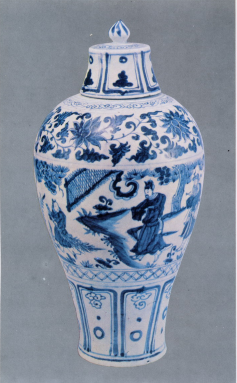
- “Three Visits to Zhuge Liang” Scene: This depicts the story from Romance of the Three Kingdoms where “Liu Bei pays three visits to the thatched cottage” to invite Zhuge Liang (courtesy name Kongming) to join his cause. This was a popular narrative theme on porcelain during the Yuan and Ming dynasties, reflecting the influence of popular dramas and novels on decorative arts at the time.
- Porcelain Vase: This refers to a specific vessel form, also commonly known as a “Yuhuchun Ping” (spring bottle). It is characterized by a flared mouth, slender neck, rounded or pear-shaped body, and a ring foot. Its elegant, flowing lines first appeared in the Song Dynasty and were very popular during the Yuan Dynasty, often used for storing wine or as display pieces.
Artistic and Technical Features
- Cobalt Pigment Color: Late Yuan blue-and-white ware used imported pigment, resulting in a jewel-like, bright, and intense blue. Where the brushstrokes were heavy, the cobalt would accumulate, forming slightly sunken “iron-rust” spots (dark brown crystalline patches) with a natural, diffused effect reminiscent of ink wash painting.
- Decoration Layout: It exhibits the typical Yuan multi-tiered decorative style. The main pictorial panel (often within a reserved cartouche) on the body depicts the primary narrative scene (“Three Visits”). The remaining areas are densely filled with auxiliary patterns, such as banana leaf bands, scrolling chrysanthemum vines on the neck, lotus petal or scroll patterns on the shoulders, and stylized lotus petal panels on the lower body. The composition is intricate yet orderly, with clear distinction between primary and secondary elements.
- Painting Technique: The figure painting is lively. Although from the late Yuan period, the style of the figures already shows tendencies toward early Ming characteristics, with fluid lines. The scene typically depicts a landscape with a thatched cottage, pine trees, and bamboo as the backdrop. The figures—Liu Bei, Guan Yu, Zhang Fei, a page boy, and Zhuge Liang—are rendered with distinct expressions, making the narrative highly engaging.
Historical and Cultural Value
- Marker of Thematic Shift: Early Yuan blue-and-white ware predominantly featured floral, bird, and dragon motifs. By the late Yuan period, narrative figure scenes such as “Xiao He Chasing Han Xin Under the Moon,” “The Descent of Guiguzi,” and “Three Visits to the Thatched Cottage” began to appear in large numbers. This artifact is a key example of this important transition, marking a shift in porcelain decoration from purely ornamental to narrative, reflecting literati aesthetic tastes.
- Fusion of Literature and Craftsmanship: Applying well-known literary stories to precious blue-and-white porcelain not only elevated the cultural status of the ceramics but also allowed these stories to be transmitted in a luxurious and enduring form. This met the aesthetic and status needs of the newly affluent classes of the time (including merchants and Mongol nobility).
- Extreme Rarity: Yuan dynasty blue-and-white vases (Yuhuchun bottles) with clear figure narrative scenes are inherently extremely rare. Each one is an invaluable treasure for studying Yuan dynasty society, culture, art, and porcelain-making technology.
Important Comparative Reference
The most famous and closely related example matching your description is the “Blue-and-White Vase with Figure Scene, Yuan Dynasty” housed in the Guangdong Museum (also referred to as the “Yuan Blue-and-White ‘Three Visits’ Yuhuchun Vase”).
- Features of This Vase: It has a standard and elegant form. The primary decoration is precisely the “Three Visits to the Thatched Cottage” scene, meticulously painted with typical Yuan blue-and-white coloring. It is considered a benchmark piece for Yuan blue-and-white figure narrative themes and is designated as a Grade One National Cultural Relic.
Authentication and Collecting Notes
Extreme caution is required if encountering similar objects on the market:
- Genuine Pieces are Extremely Rare: Most top-tier Yuan blue-and-white pieces with such themes are housed in world-renowned museums (such as the British Museum, Topkapi Palace in Turkey, the National Museum of Iran) or held by a handful of major collectors. Their appearance on the open market is exceedingly unlikely.
- Numerous Imitations Exist: Imitations were produced during the Ming, Qing, and modern periods. Authentication requires rigorous examination of multiple aspects: body clay (Yuan porcelain bodies are substantial, coarse yet refined, often showing “fire-rust” reddish patches), glaze surface (bluish-white, glossy and smooth), cobalt pigment color, painting style, and overall period sensibility.
- Professional Evaluation Required: Any suspected object must undergo a comprehensive assessment combining scientific testing and visual examination by authoritative institutions and experts.
In summary, the “Porcelain Vase with Blue-and-White Decoration Depicting the ‘Three Visits to Zhuge Liang’ from the Late Yuan Dynasty” you described represents one of the highest artistic achievements of the Yuan dynasty Jingdezhen kilns. It is not merely an exquisite piece of porcelain but also a historical narrative painted on a three-dimensional vessel, carrying the rich culture of the Three Kingdoms period and the spirit of its time. It is a radiant pearl in the history of Chinese ceramics.