

1. What is “Mise Porcelain”?
The term “Mise porcelain” itself carries an air of mystery.
- Meaning of “Mi” : There have been various interpretations throughout history. One theory suggests it refers to a “secret” and technique, exclusively for imperial use and forbidden to the common people. Another theory posits that “Mi” describes its mysterious and indescribably beautiful glaze color.
- Historical Records: The Tang poet Lu Guimeng, in his poem “The Secret Color Yue Ware,” wrote the immortal lines: “When the Yue Kiln opens in the autumn frost and breeze, It captures the green of a thousand peaks.” This vividly depicts the green, luminous, and jade-like glaze of Mise porcelain.
- An Age-Old Mystery: For a long time, Mise porcelain was only mentioned in texts, and no one could confirm its true appearance until the 1987 archaeological discovery at the Famensi Temple Tang Dynasty Underground Palace in Shaanxi.
2. The Astonishing Discovery at the Famensi Underground Palace
In 1987, within the underground palace of Famensi Temple, sealed for over a thousand years, 14 exquisite celadon pieces were unearthed. The accompanying inventory stele clearly recorded: “Seven Mise bowls, two with silver rims. Six Mise plates and dishes in total.“
This discovery was epoch-making:
- Establishing a Standard: These 14 celadon pieces were confirmed as definitive Tang Dynasty Mise porcelain, providing the most authoritative standard for its identification worldwide.
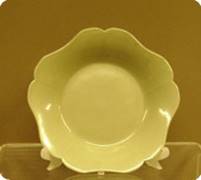
- Solving the Mystery: The ancient puzzle was finally solved, allowing people to see the true face of Mise porcelain. The “Five-Lobed Mise Porcelain Plate” you asked about is one of these 14 treasures.
3. Appreciating the “Five-Lobed Mise Porcelain Plate”
Taking this national treasure from Famensi as an example, we can appreciate its beauty from the following perspectives:
- Shape – “Five-Lobed”
- Five Lobes: The rim is divided into five equal segments, resembling five flower petals.
- Mallow-shaped Rim: Describes the rim’s shape, similar to that of a mallow flower, with an elegant curved notch at each lobe. This gives the entire form a sense of flow and rhythm, imitating natural flowers, making it vivid and elegant. This was a very popular artistic form in the Tang Dynasty.
- Glaze Color – “Seemingly born from nothing, like ice resembling jade”
- This is the soul of Mise porcelain. Its glaze color is a greenish, luminous, and smooth, like a tranquil lake or warm, polished ancient jade.
- The glaze layer is even and thick, exhibiting a glass-like luster yet containing a soft, inner light, not glaring or ostentatious.
- Most notably, many Mise plates and bowls were fired using saggers, sealed with glaze, and fired in a reducing atmosphere, which was essential for achieving such a pure, flawless glaze color.
- Craftsmanship – “As skillful as casting metal, as refined as carving jade”
- The body is fine, dense, and hard, gray-white in color, producing a clear, ringing sound when tapped.
- The walls can be made exceptionally thin, demonstrating extremely high throwing and trimming skills.
- The entire piece is glazed, with a surface as smooth as a mirror, almost flawless.
- Artistic Realm – An Epitome of Tang Grandeur
- This plate perfectly integrates form and color. The lively lobed shape combined with the serene Mise glaze achieves the highest artistic realm of “a lotus rising clear from the water, naturally adorned, carving and polishing discarded.”
- It does not rely on decorative patterns for appeal but uses ultimate form, glaze color, and texture to showcase the Tang Dynasty’s aesthetic taste—revering nature, pursuing elegance, and embodying confident composure.
4. Historical and Cultural Value
- Imperial Use: Mise porcelain was used by the late Tang imperial family as the highest-grade offering to venerate the Buddhist relic (Buddha’s finger bone), highlighting its esteemed status.
- A Pearl in Ceramic History: It represents the highest level of celadon production at the time and is a precursor to the top-tier celadons of the subsequent Song Dynasty, such as Guan and Ru wares.
- Cultural Symbol: It transcends being a mere utilitarian object, becoming a symbol of Tang Dynasty culture, art, and technological process.