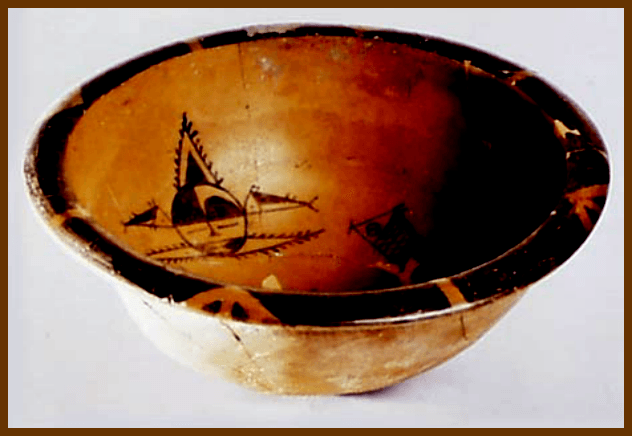
Painted Pottery Basin with Human-Fish Motif(Yangshao Culture, Banpo Type)
Height: 16.5 cm, Diameter: 39.5 cm
Excavated from the Banpo site, Xi’an, Shaanxi Province
Housed in the National Museum of China
Detailed Analysis
1. Basic Information
- Period: Neolithic Age (approx. 6000–7000 years ago)
- Excavation Site: Banpo site, Xi’an (1955), a key settlement of the Yellow River civilization
- Dimensions: Height 16.5 cm, Mouth diameter 39.5 cm (ergonomic design for handheld use)
- Material & Technique: Fine red clay pottery, painted with mineral pigments, fired at 900–1000°C
2. Decorative Motifs
- Human Face Design (two symmetrical groups inside the basin)
- Circular face with a triangular headdress
- Narrowed eyes in a meditative expression
- Mouth holding two stylized fish
- Fish-tail motifs near the ears
- Fish Motif (alternating with human faces)
- Highly abstract geometric rendering
- Crosshatched patterns representing scales
- Scissor-like forked tail fins
3. Cultural Significance
- Totemism Theory: Possibly reflects Banpo people’s fish totem worship
- Shamanism Theory: Ritual vessel; human face may depict a shaman
- Fertility Symbolism: Fish as a metaphor for abundance and reproduction
- Funerary Connection: Often found in children’s burial urns, suggesting ceremonial use
4. Artistic Features
- Composition: Balanced repetition with negative space
- Color Scheme: Primarily black pigment (manganese-based), with red accents (iron oxide)
- Technique: White slip applied before painting with brush-like tools
5. Historical Value
- One of China’s earliest surviving portrait artworks
- Evidence of complex religious art in Neolithic society
- Reflects transition from fishing-hunting to early agriculture
6. Related Discoveries
- Similar motifs found at Jiangzhai site (Lintong)
- Variant fish-bird designs in Dadiwan (Gansu) pottery
- DNA studies link Banpo people to ancient North Chinese populations
This artifact is part of the National Museum of China’s permanent collection and is listed among the 195 Cultural Relics Forbidden to Be Exhibited Abroad. Its enigmatic symbolism continues to inspire academic research, making it a masterpiece of early Chinese civilization.