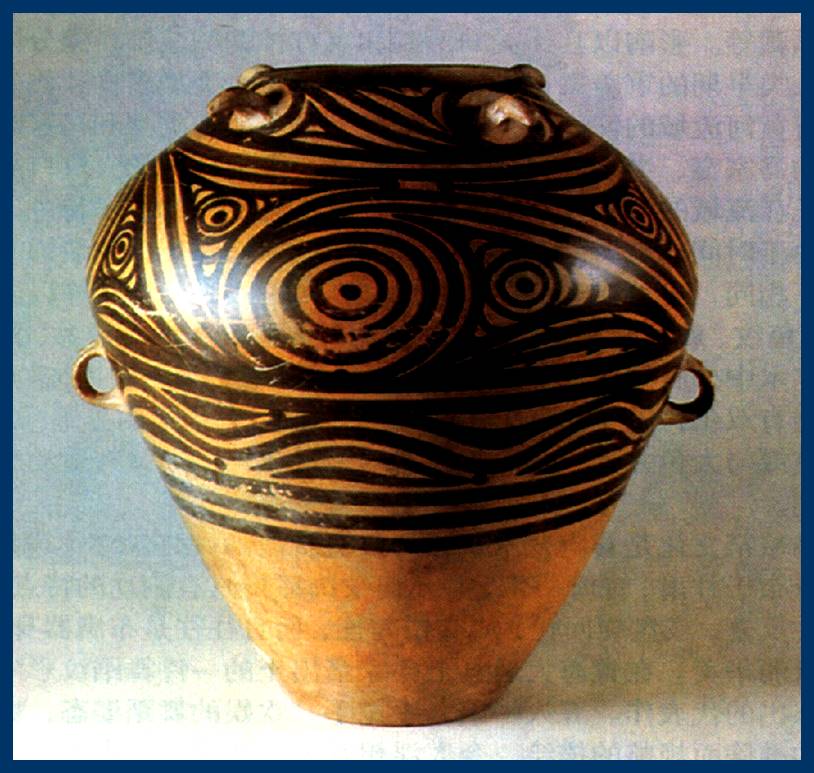
Pottery Vase with Whorl Patterns (also known as Painted Pottery Jar with Four Handles and Concentric Circle Designs) is a representative artifact of the Majiayao culture, with its artistic and historical significance interpretable from multiple perspectives:
1. Cultural Context and Technical Features
- The Majiayao culture (c. 3300–2050 BCE) was a significant late Neolithic culture in the upper Yellow River region, renowned for its advanced pottery-making techniques. This vessel, standing at 50 cm tall, is a large-scale painted pottery piece, demonstrating sophisticated coil-building techniques and kiln control.
- The classic black-on-orange color scheme reflects the typical style of Majiayao pottery. The four symmetrically placed handles suggest both practicality and ritual significance, possibly used in ceremonies or important communal events.
2. Cosmological Symbolism in the Decorations
- The combination of concentric circles and whorl patterns is not merely decorative: Archaeologist Zhang Pengchuan proposes that these motifs may symbolize prehistoric people’s observations of the Yellow River’s hydrological phenomena or abstract representations of celestial movements (e.g., solar worship).
- The tripartite composition (rim, neck-shoulder, and belly) might correspond to a primitive “three-world” cosmology, with the belly’s swirling patterns possibly representing water cycles—an essential concept for Majiayao’s rice-farming communities dependent on river systems.
3. Breakthrough in Dynamic Aesthetics
- Through precise spacing of vortex centers and gradually fading curves, the potters achieved a “whirling water” visual effect. This dynamic balance is rare in prehistoric art, predating spiral patterns in other Eurasian cultures by nearly a millennium.
- Professor Yan Wenming of Peking University notes that the evolution of such motifs (from realistic water ripples to geometric abstraction) reflects a cognitive leap in prehistoric thinking—from concrete representation to symbolic abstraction.
4. Archaeological Significance
- Unearthed in 1956 at Sanping site, Yongjing County, Gansu, this vessel was found alongside carbonized millet grains and bone flutes, suggesting its possible use in ritual music and dance ceremonies. Its location near the Yellow River gorges implies that the whorl patterns may be a sacred depiction of turbulent waters.
- Now housed in the National Museum of China, this piece—alongside the Dancing Figures Painted Pottery Basin from Zongri site, Qinghai—forms a dual masterpiece of Majiayao art: one capturing the rhythm of water, the other the movement of humans.