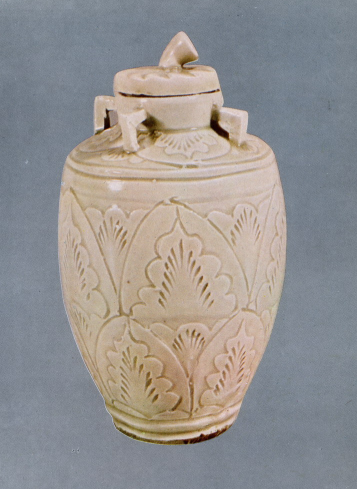
Overall Characteristics and Artistic Value
This lidded jar embodies the peak craftsmanship and aesthetic pursuit of Northern Song Ding white porcelain:
- Form: The shape is full, dignified, and stable. The body is globular with smooth, elegant lines, typical of the classic Song dynasty elegance. The presence of the original lid, perfectly proportioned to the jar itself, is exceptionally rare and adds to its significance.
- Glaze: Ding white porcelain is not pure white but has a warm, ivory or off-white hue, giving a soft and subtle feeling. The glaze is lustrous and smooth with a gentle sheen, resembling fat or jade. The warm luster and ivory tone visible in the image are highly characteristic.
- Decoration – Incised Floral Motif:
- Technique: “Incising” is one of the most representative decorative techniques of the Ding kiln. Artisans used tools to cut into the leather-hard body at a slanted angle, creating lines of varying depth and richness. This “slanted knife” technique creates a relief-like, three-dimensional effect, with one side of the line being deep and sharp and the other shallow and fading.
- Theme: The floral petal motif is fluid and natural, with a well-composed layout. The incised petals are vivid and succinct, not pursuing realism but focusing on the spirit and rhythmic flow of the lines, full of abstract and decorative beauty. This reflects the Song literati’s aesthetic ideal of embracing nature, subtlety, and elegance.
- Body: Ding porcelain has a fine, white clay body that is hard and often quite thin. Through the glaze, one can sometimes vaguely see the clear incised lines on the body, a characteristic known as “translucency,” which is a feature of high-quality Ding ware.
Historical and Cultural Context
- Ding Kiln: Located in present-day Quyang County, Hebei Province, it was one of the “official kilns” producing ceramics for the imperial court during the Northern Song Dynasty, while also mass-producing wares for civilian use. Its products were highly influential, forming a vast “Ding ware system.”
- Function: Such lidded jars were utilitarian objects, possibly used for storing tea, spices, medicine, or items in a lady’s dressing case. Those who owned pieces with such exquisite decoration were likely nobility, scholars, or wealthy families, not commoners.
- Aesthetic Paradigm: This piece perfectly exemplifies the Song dynasty’s artistic realm of “refined simplicity” and “lasting resonance.” Without flashy colors, it relies solely on a pure form, a warm glaze, and lively incised decoration to create infinite charm and enduring appeal.