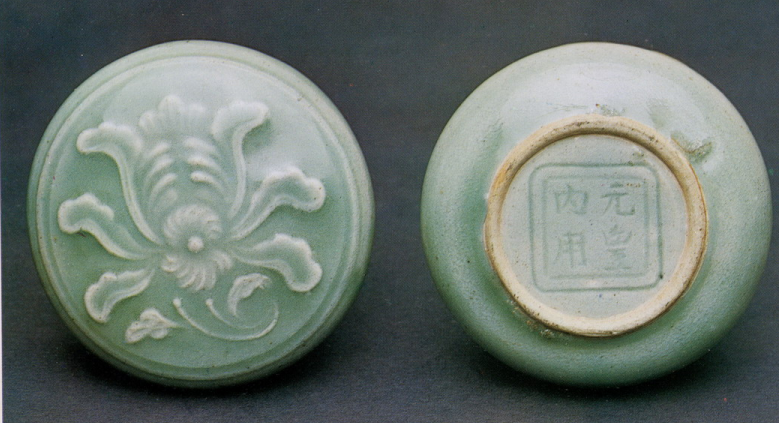
1. Kiln: Longquan Kiln
- Location: Situated in present-day Longquan City, Zhejiang Province, it was one of the most famous celadon-producing kiln systems of the Song Dynasty, achieving unprecedented scale and widespread influence, including overseas.
- Characteristics: Renowned for its celadon wares, featuring jade-like green glazes that are rich, lustrous, and moist in texture. Its masterpieces include legendary shades such as “Fenqing” (powder-green) and “Meiziqing” (plum-green).
2. Glaze Color: Fenqing (Powder-Green)
- This is one of the supreme glaze colors developed by the Longquan Kiln during the Southern Song period, representing the pinnacle of Chinese celadon artistry.
- Visual Characteristics: A soft, pale bluish-green hue, reminiscent of clear, serene spring lake water. The glaze surface has a warm, gentle luster with a texture resembling fine jade.
- Technique: Achieved through multiple layers of glaze applied and fired at high temperatures. The glaze layer contains numerous tiny bubbles and unmelted quartz particles, which scatter light softly, creating an opaque, opalescent, jade-like quality.
3. Form: Box
- Function: Porcelain boxes were highly popular daily-use items in the Song Dynasty. Their purposes varied based on size and decoration:
- Cosmetic Box: Most common, for holding rouge, face powder, etc.
- Incense Box: For storing incense pellets or cakes.
- Medicine Box: For herbs or lip balm.
- Seal Paste Box: A scholar’s studio accessory.
- Design: Typically a flattened circular shape, comprising a lid and a body that fit together via a recessed rim (“zi-mu” mouth). The form is elegantly simple with smooth, rounded lines. The lid surface often bears carved, incised, or molded decorations such as flowers, water waves, or playing children, though some are left plain.
4. Period Characteristics: Song Dynasty (especially Southern Song)
- Song aesthetics valued simplicity, subtlety, and naturalness. This Fenqing box embodies that ideal:
- Form: Dignified, well-proportioned, and harmonious, prioritizing lyrical beauty over ornate complexity.
- Glaze: Pursued a natural, jade-like texture rather than a shiny, glassy finish.
- Decoration: If present, patterns like incised or carved designs are subtle and integrated with the glaze, appearing faintly visible.
Key Points for Collection and Authentication
- Glaze: Authentic Fenqing glaze is soft, reserved, thick, and radiates an inner glow. Replicas often have colors that are too bright, glossy, or dull.
- Body: The clay body is grayish-white and fine-textured. The unglazed foot ring often shows traces of oxidation (“fire-rust red”).
- Craftsmanship: The piece is neatly trimmed but shows hand-made marks. The foot ring is precisely finished.
- Crackle: Some pieces may have natural “ice crackle” or colorless crackling, though many Fenqing glazes are crackle-free.
- Signs of Use: Genuine antiques should show natural wear from age (e.g., on the rim of the box and lid).
Market and Value
- Song Dynasty Longquan Kiln Fenqing boxes are highly sought after in international auction markets and by top collectors.
- Their value depends on factors such as period (Southern Song being most prized), quality of the glaze (purity and jade-like texture of the Fenqing), size, refinement of decoration, and condition.
- Intact pieces with exquisite glaze can command prices ranging from hundreds of thousands to millions of RMB. Even small items hold significant artistic and historical value.
In summary, a “Song Dynasty Longquan Kiln Fenqing Box” is not merely an ancient container but a perfect crystallization of the refined aesthetic of Song Dynasty life and the peak ceramic technology of the Longquan Kiln. Its jade-like powder-green glaze, transcending a millennium, still conveys a sense of tranquility and warmth.