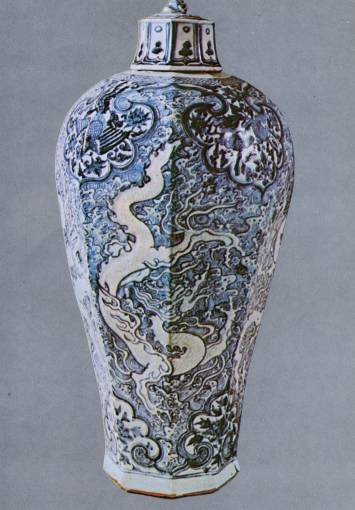
I. Core Characteristics (Yuan Dynasty Blue-and-White Octagonal Vase)
- Form and Craftsmanship:
- Octagonal Shape: Unlike common round bottles or jars, the octagonal form requires segmenting, assembling, and refining the clay body, demanding high technical skill from the potter and resulting in a low success rate. This reflects the bold innovation and technical breakthroughs in Yuan porcelain forms.
- Typical Shapes: Possibly based on the silhouette of classic forms like the “Yuhuchun Ping” (spring vase), “Meiping” (prunus vase), or “Hulu Ping” (double-gourd vase), but rendered with eight facets. It could also be a variant of an octagonal flattened flask or an octagonal ever.
- Body: The body is typically thick and heavy, feeling substantial in hand. The clay uses a “binary formula” (porcelain stone mixed with kaolin), but refining was not as meticulous as in later Ming and Qing dynasties. Therefore, the body texture appears somewhat coarse and loose. On large vessels, obvious joining lines, wheel marks, and “fire-red” (rust-colored spots on exposed clay) are often visible at connections, the base, and interior.
- Cobalt Blue Color and Glaze:
- Cobalt Pigment: Uses imported “Sumali” or “Samarra” blue cobalt pigment from Persia (modern-day Iran). This pigment is high in iron and low in manganese. After firing, it produces a rich, sapphire-like blue with distinctive “iron rust spots” and “metallic sheen” (dark crystalline speckles with a metallic luster).
- Bleeding and Tonal Variation: Sumali blue tends to bleed during painting, creating a halo effect at the edges of motifs, resembling ink-wash painting. It exhibits variations in shade and depth.
- Glaze Surface: The glaze is white with a bluish tinge, resembling a duck egg blue. It is thick, lustrous, and has a strong glass-like quality. Areas where glaze accumulates (like the lower body or recessed corners) often appear aqua-green.
- Decoration and Layout:
- Dense Composition: Influenced by Yuan decorative arts aesthetics, patterns are richly layered. Typically, there are 7 to 9 decorative bands from top to bottom, clearly distinguishing primary and secondary elements but covering most of the surface with little empty space.
- Classical Motifs:
- Primary Decoration: Commonly found in reserved panels (cartouches) or the main areas of the belly, such as scrolling peonies, scrolling lotus, clouds and dragons, fish and aquatic plants (mandarin fish, carp), phoenixes amid flowers, and historical figure narratives (e.g., Xiao He Chasing Han Xin under the Moon, Guiguzi Descending the Mountain). Narrative figure scenes are particularly prized.
- Secondary/Border Patterns: On the rim, neck, shoulder, and foot, you find scrolls, scrolling flowers, turbulent waves (hai shui jiang ya), stylized lotus petals (often with “Eight Buddhist Emblems” inside), banana leaf patterns, fret patterns, and lozenge diaper patterns.
- Painting Style: The brushwork is free, bold, and powerful, using “single stroke” techniques, flowing naturally without拘泥 (excessive拘泥) on details. Figures, animals, flowers, and leaves are vividly rendered and full of life.
II. Significance and Market Value
- Artistic Value: Represents the pinnacle of 14th-century global ceramic technology and painting art, a crystallization of East-West cultural exchange (Chinese craftsmanship with Persian raw materials).
- Historical Value: Extremely few survive. Most Yuan blue-and-white was made for export or for court/noble use; intact pieces excavated or handed down within China are exceptionally rare.
- Market Value: If authentic and in excellent condition, especially pieces with narrative figure scenes, the value can reach hundreds of millions to over a billion RMB. For example, the “Guiguzi Descending the Mountain” Yuan blue-and-white jar sold at Christie’s London in 2005 for approximately £14 million (about 230 million RMB at the time), setting a then-world record for Chinese artwork.
III. Appreciation and Authentication Points (Require Extreme Caution)
Given their immense value, the market is flooded with imitations. Any object claimed to be a “Yuan Dynasty Blue-and-White Octagonal Vase” must be scrutinized with the strictest standards:
- Form and Craftsmanship: Examine if the facet lines are straight and流畅 (fluent), and if the joining lines appear natural (imitations are often overly neat or contrived). Does the weight feel appropriate (imitations can be too heavy or light)?
- Cobalt Pigment and Glaze: Are there characteristic iron rust spots and bleeding indicative of Sumali blue? Modern chemical cobalt struggles to perfectly mimic its natural sinking and crystallization. Is the glaze luster温润如玉 (warm and jade-like)? Imitation glazes often appear too glaring or dull.
- Decoration and Painting Style: Does the painting possess the distinctive verve and strength of the Yuan style? Is the layout dense yet orderly? Imitations often appear stiff, rigid,拘谨 (cautious), with hesitant brushstrokes.
- Base and Aging Signs: Are the “fire-red” spots and body texture on the exposed base natural? Does the glaze surface show natural signs of age (like a soft patina, wear marks)? Artificial aging on imitations (acid etching, sanding) often appears uniform and forced.
IV. Important Recommendations
- If you are a collector: When encountering such an object, first assume it is a modern high-quality reproduction and remain冷静 (calm). Take high-resolution, multi-angle photos (especially focusing on the base, interior, joins, and detailed shots of decorations).
- Seek Professional Appraisal: Never trust a seller’s story or provided certificates. Contact the most authoritative institutions in China, such as:
- The National Committee for the Identification of Cultural Relics (relevant experts)
- Porcelain department experts from the Palace Museum or the National Museum of China
- The Shanghai Institute of Ceramics, Chinese Academy of Sciences (can perform scientific testing to analyze body and glaze composition)
- A few top-tier auction houses with recognized expertise in Yuan blue-and-white authentication (e.g., Christie’s, Sotheby’s Chinese Ceramics departments)
- Study Museum References: Consult catalogues of Yuan blue-and-white pieces in renowned museums worldwide, for example:
- Topkapi Palace Museum, Turkey
- National Museum of Iran
- British Museum
- Gao’an Museum, Jiangxi Province, China (hoard of excavated Yuan blue-and-white)
- Palace Museum, Beijing
In summary, a “Yuan Dynasty Blue-and-White Octagonal Vase” is a jewel in the crown of porcelain collection, exceedingly rare in the world. Any piece circulating in the market must undergo the most rigorous scrutiny by world-class experts and scientific testing to determine its authenticity.