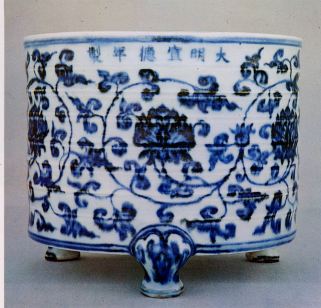
1. Historical Context
- Emperor Xuande (Zhu Zhanji) reigned during a period of economic prosperity, and the imperial court held extremely high standards for porcelain production. The Xuande official kilns were renowned for their meticulous material selection and rigorous craftsmanship, with blue-and-white porcelain achieving exceptional acclaim.
- Blue-and-white pigment: Primarily imported “Sumali blue” (also known as Su ma li qing), which produced rich, deep hues with characteristic “iron rust spots” (tin spots) and a natural, diffuse ink-wash effect.
2. Form and Technical Features
- Shape
Xuande blue-and-white censers often followed archaic bronze designs, commonly including:- Li-style censer: Three legs, with raised ridges on the belly, imitating Shang and Zhou dynasty bronze li.
- Cylindrical censer: Straight mouth, cylindrical body, supported by three legs, dignified and simple.
- Ding-style censer: Double handles and three legs, densely decorated, reminiscent of bronze ritual vessels.
- Bowl-style censer: Rounded belly and contracted mouth, stable and imposing.
- Blue-and-white Coloration
- Sumali blue pigment appears vibrant and translucent, with visible iron oxide spots (tin spots) within the lines and a diffuse, ink-wash effect that creates rich layers.
- Some pieces used domestic cobalt, producing grayer and lighter hues, but official kiln wares predominantly employed imported pigment.
- Decorative Themes
- Floral patterns: Lotus scrolls, peonies, lingzhi mushrooms, chrysanthemums, etc., often with auspicious meanings.
- Animal motifs: Dragons, phoenixes, qilin, sea creatures, etc. Dragon designs are fierce, while phoenixes are elegant and flowing.
- Geometric patterns: Huiwen (key-fret), “flaming waves and mountain peaks,” scrolling grass borders, with balanced density in composition.
- Inscriptions: Sanskrit or祈福 scriptures occasionally appear on the body, while a few bear the six-character mark “大明宣德年制” (Made in the Xuande reign of the Great Ming) in regular script (blue-and-white or incised).
- Body, Glaze, and Workmanship
- The body is thick, dense, and sturdy. The glaze surface is rich and lustrous, with a bluish tint (commonly called “liangqing glaze”). The foot is finely finished, often showing traces of “fire-red” or adhering sand.
3. Mark Characteristics
- Xuande official kiln marks vary, including “宣德年制” or “大明宣德年制,” mostly in regular script, found on the base, mouth rim, or shoulder.
- The blue pigment in the marks is deep and concentrated, with strong, well-structured calligraphy reflecting the style of Jin and Tang dynasty regular script.
4. Market and Collectible Value
- Rarity of Authentic Pieces
Xuande official kiln works are extremely rare. Blue-and-white censers were primarily used for imperial Buddhist rituals or sacrifices, making surviving examples exceptionally scarce. Market values can reach tens of millions to over a hundred million RMB (e.g., Xuande blue-and-white fish-and-waterweed censers or seawater-dragon censers sold at auctions). - Identification of Imitations
- Imitations were produced in later Ming and Qing periods (especially Jiajing, Wanli, Kangxi, and Yongzheng reigns) as well as in modern times. Differentiation requires attention to pigment, body, glaze, and mark details.
- Authentic pieces have naturally embedded iron spots, while imitations often show superficial spotting. Authentic bodies are fine and contain “macang clay,” whereas imitations may be overly white or porous.
- Research Significance
Xuande blue-and-white censers blend bronze culture with porcelain craftsmanship, reflecting the imperial aesthetic of the Ming Dynasty and cultural exchanges (e.g., cobalt imported from West Asia). They serve as important artifacts for studying Ming art history and material culture.
5. Notable Examples
- Xuande Blue-and-White Seawater Dragon Censer with High Foot (Palace Museum, Beijing): Decorated with fierce dragons soaring over waves, majestic and powerful.
- Xuande Blue-and-White Lotus Scroll Triple-Legged Censer (British Museum): Fluid motifs with distinct Sumali blue characteristics.
- Xuande Blue-and-White Sanskrit-Inscribed Censer with Flanges (can also function as a censer): Incorporates Buddhist elements, reflecting multicultural influences.
6. Authentication Recommendations
For authenticating physical objects, consider the following:
- Diffusion and iron spots in blue pigment: Authentic pieces show deep, natural penetration into the body, while imitations appear forced and stiff.
- Aging traces on body and glaze: The glaze should be warm and lustrous, with natural wear on the foot and transitional “fire-red” spots.
- Calligraphy of marks: Authentic marks exhibit vigorous brushstrokes, while imitated marks often appear hesitant or traced.
- Scientific testing: When necessary, compositional analysis (e.g., Sumali blue is high in iron and low in manganese) can be applied.