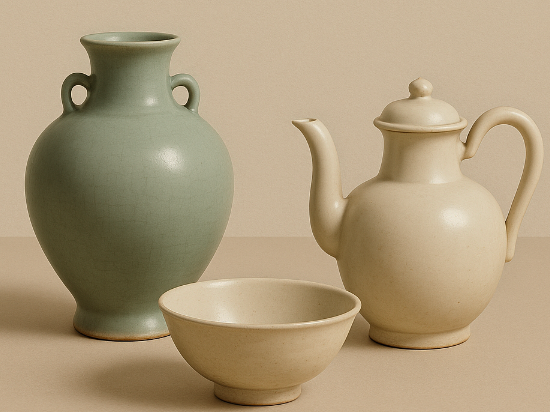


Song and Yuan porcelain is not a monolithic art form, but rather a brilliant duet between the minimalist aesthetics of official kilns and the vibrant vitality of folk kilns. This article will guide you through this artistic sonata spanning four hundred years.
When we talk about Song and Yuan porcelain, what are we discussing? Is it the soft, jade-like celadon of Ru ware, or the unrestrained black-and-white paintings on Cizhou ware? In fact, this four-hundred-year history is not a solo performance by a single voice, but a dual sonata composed jointly by the “minimalist aesthetics” of the official kilns and the “folk vitality” of the folk kilns.
First Movement: The Minimalist Aesthetics of Official Kilns – A Meditation on Rationality
The Song Dynasty was an era of highly awakened literati consciousness. Driven by the imperial court and scholar-officials, official kiln porcelain elevated minimalist aesthetics to an unprecedented level. This aesthetic did not lie in complex ornamentation, but in the pursuit of the ultimate harmony of material, glaze, and form itself.
- The Pinnacle of Ru Ware: The sky-blue glaze of Ru ware is praised as “the color of the sky after rain, as the clouds break.” Its glaze is lustrous and smooth, warm and thick like accumulated fat, with fine crackling on the surface, pursuing an introverted, subtle, and unostentatious elegance. The tiny sesame-seed spur marks on its base perfectly integrate precise craftsmanship with restrained aesthetics.
- The Character of Guan Ware: The Northern and Southern Song Guan kilns, inheriting the spirit of Ru ware, pursued the appeal of “purple mouth and iron foot” and natural “ice crack” patterns. This concept of finding beauty in imperfection reflects the Song people’s philosophical contemplation, which revered nature and probed essence. Their shapes are simple and fluid, without any superfluous decoration; all beauty is concentrated in the jade-like glaze and elegant lines.
- The Green Jade of Longquan: The powder green and plum green glazes of the Southern Song Longquan kilns brought the jade-like quality of celadon to its peak. That deep, mysterious green, tranquil and noble, is the materialized embodiment of the Song literati’s aesthetic ideal: “Like a lotus rising clear from the water, naturally carved and embellished.”
Official kiln wares were vessels for the rationality and spirit of the scholar-officials, exuding an aura of unquestionable authority and refinement in their serenity.
Second Movement: The Vibrant Vitality of Folk Kilns – A Ode to Life’s Joy
In stark contrast to the contemplation of the official kilns was the vibrant vitality bursting forth from folk kiln porcelain. Not made for imperial decree but for the market and daily life, they were filled with the passion and creativity of the human world.
- The White and Black of Cizhou Ware: Cizhou ware was a giant among northern folk kilns. Its innovative “black flowers on white ground” technique was like painting in ink on porcelain. The depicted peonies, phoenixes, and children at play, executed with bold brushwork and fluid lines, were full of dramatic tension and rustic charm. It was a direct outpouring of unadorned, fervent folk emotion.
- The Vigorous Blade of Yaozhou Ware: Although also celadon, Yaozhou green ware differed from the quiet solemnity of Ru and Guan wares. Its incised decoration was sharp and free, the patterns rendered bold and fluid under the knife, full of dynamism and strength, reflecting the robust and simple aesthetics of the northern people.
- The Decorative Whimsy of Jizhou Ware: Jizhou ware took the whimsical ideas of the folk to the extreme. Techniques like leaf-imprinting and paper-cut applique transformed ordinary objects from nature and daily life into eternal art, imbued with a naive charm and unique style.
Folk kiln wares were products beautified for practical use and the enjoyment of the common people, displaying endless creativity and the joy of existence in their boisterousness.
Finale: Fusion and Expansion in the Yuan Dynasty
In the Yuan Dynasty, this dual sonata encountered a new variation. The official kiln system declined, and folk kilns became the absolute protagonists. The dramatic rise of Yuan blue-and-white porcelain was precisely the product of this fusion – it retained the refined body and glaze techniques of the Song Dynasty while incorporating the powerful momentum of folk painting and the decorative style of foreign cultures. The magnificent emergence of blue-and-white porcelain was the result of the accumulated and explosive artistic energy of the Song and Yuan eras within the folk kilns.
The greatness of Song and Yuan porcelain lies not in the dominance of a single style, but in the coexistence and dialogue between this “minimalism” and “vitality.” The serenity of the official kilns teaches us to appreciate inner richness; the exuberance of the folk kilns lets us feel the warmth of life. This brilliant duet collectively defined one of the most philosophically profound and humanistically resonant eras in the history of Chinese ceramics.