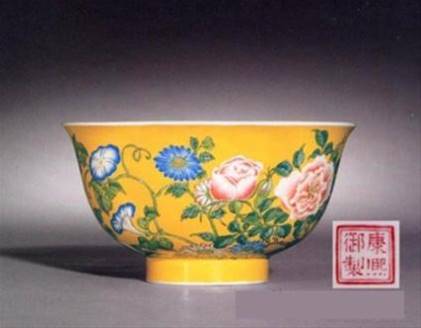
Key Characteristics of Kangxi Imperial Bowls
- Fine Body: The clay used for Kangxi porcelain was meticulously washed and purified. The body is hard, fine, and compact, with a texture often compared to “rice broth.” Pieces feel substantial and heavy in hand.
- Bold Shapes: The overall style of Kangxi period porcelain is upright, vigorous, and majestic. Bowls are often dignified, regular in form, with strong, powerful lines.
- Bright, Tight Glaze: The glaze is lustrous and moist. It adheres tightly to the body, exhibiting a unique “hard, bright blue-green glaze” with a distinctive sheen that is brilliant yet not harsh, commonly called “treasure light.”
- Meticulous Base and Foot: The foot rings of official kiln bowls are perfectly trimmed, rounded, and smooth, known as “loach’s back.” The reign marks on the base are standardly written, mostly as six-character marks in underglaze blue in double or triple lines, reading “Made in the Great Qing Kangxi Era.” The calligraphy is upright and powerful.
Classic Types of Kangxi Imperial Bowls
The variety of Kangxi Imperial Bowls is extremely rich. The most famous types include:
1. Blue and White Bowls
- Characteristics: Used local Zhejiang cobalt and Yunnan Zhuming cobalt. The blue coloration is vibrant and sapphire-blue, with distinct tonal layers, earning the praise “blue-and-white in five colors.” Painting techniques were superb, using the “divided-wash” method to achieve the effect of ink washes in different intensities in traditional Chinese painting.
- Common Motifs: Landscapes with figures, lotus scrolls, dragon patterns, antiquities, the “Three Friends of Winter” (pine, bamboo, plum).
2. Underglaze Red and Blue & White with Underglaze Red Bowls
- Characteristics: The Kangxi period revived and perfected underglaze red technique, achieving pure and vibrant red hues. Combining underglaze blue and underglaze red was technically extremely challenging, making successful pieces highly precious.
- Common Motifs: The “Three Fruits,” dragon patterns, flowers.
3. Wucai (Five-Color) Bowls
- Characteristics: Kangxi Wucai is known as “hard colors,” with strong color contrasts and bright reds and greens. Its blue was applied directly over the glaze, replacing the Ming practice of using underglaze blue. The painting style is bold and unconstrained, with forceful brushstrokes.
- Famous Example: While they are cups, the Twelve Mooncakes (Monthly Flower Cups) represent the pinnacle of Kangxi Wucai and their concept can be analogized to bowls.
4. Doucai (Contending Colors) Bowls
- Characteristics: Colors are filled within outlines drawn in underglaze blue, creating a dazzling contrast between the underglaze blue and overglaze enamels. They appear more magnificent than Chenghua Doucai.
5. Monochrome Glaze Bowls
- Peachbloom Bowls: A precious copper-red glaze variety. The glaze color is elegant and light, like pink peach blossoms, often with green speckles. Typically small studio objects; bowls are very rare and extremely valuable.
- Langyao Red Bowls: Imitating the Ming Xuande “gemstone red” glaze. The color is deep and brilliant, like ox-blood, with a strong glassy surface. Known for a white rim (“mouth”), pooling glaze that stops neatly before the foot (“foot”), and a non-dripping quality.
- Yellow Glaze Bowls: A color reserved for imperial use. Divided into “tender yellow,” “lemon yellow,” etc., based on shade, reflecting the hierarchy system.
- “Underglaze Three Colors” Bowls: Features underglaze blue, underglaze red, and added bean-green color, used to depict landscapes in underglaze colors, creating an elegant style.
Market Value and Authentication Points
- Value: Genuine Kangxi Imperial Bowls are top-tier treasures in the auction market, often fetching millions or even tens of millions of RMB. Their value depends on type, condition, size, rarity of decoration, and provenance.
- Authentication Points:
- Examine Body and Glaze: The texture of the body and the feel of the glaze on genuine pieces possess an “antique aura” and soft luster that are difficult for modern replicas to imitate.
- Examine Painting Style: The painting from the Kangxi period is natural, fluid, and powerful, with lively figures.
- Examine the Foot Rim: The trimming method of the foot rim, the presence of “fire-rust” spots, and the style of the reign mark are crucial for authentication.
- Seek Professional Institutions: Due to the proliferation of high-quality fakes, the safest approach if you possess a similar piece is to have it authenticated by experts from institutions like the Palace Museum, the National Museum, or top auction houses like Sotheby’s or Christie’s.
Example: Kangxi Enamel Bowls
Among all Kangxi Imperial Bowls, enamel painted bowls are the highest grade and most precious. In the late Kangxi period, under the emperor’s direct guidance, the Palace Workshops successfully created enamel painted porcelain.
- Characteristics: Using imported enamels, paintings were applied by court artists in the palace onto white porcelain bodies fired in Jingdezhen, followed by low-temperature firing. The colors are gorgeous, with a sense of three-dimensionality, and the painting is extremely refined, often featuring floral patterns. The interior of the bowls is usually covered with white glaze.
- Marks: The base marks are often four-character Kangxi yuzhi (“Kangxi Imperial”) in regular script, written in enamel pigment (blue or red).
- Status: Enamel painted porcelain represents the pinnacle of “court art.” Extremely few were produced, with the vast majority housed in the Palace Museums in Beijing and Taipei. They rarely appear on the market; when they do, they command astronomical prices.
In summary, “Kangxi Imperial Bowls” represent one of the peaks of Qing Dynasty porcelain art. If you wish to learn more, it is recommended to visit museums (such as the Palace Museum, Shanghai Museum, etc.) to observe the aura and details of genuine pieces, which is far more intuitive than just looking at pictures.