Core Features and Value
- Form (Plum Blossom Vase or Meiping):
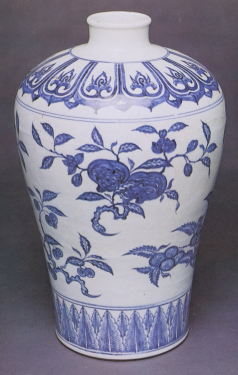
- Classic Shape: The Yongle Meiping is renowned for its exceptionally graceful form, characterized by a very small mouth, short neck, full shoulders, a slender body that tapers gradually, and a slightly flared foot. The overall lines are smooth and gentle, creating a slender, elegant silhouette with harmonious proportions that perfectly unites utility and artistry.
- Functional Evolution: Originally used as a wine storage vessel and already popular in the Song Dynasty, the Meiping gradually evolved into an ornamental piece or a vessel for displaying flowers during the Ming Dynasty.
- Body, Glaze, and Blue Pigmentation:
- Body: Thanks to advancements in clay refinement, Yongle porcelain bodies are extremely fine and pure white. They are notably thin and light (earning the description “thin as paper”) yet perfectly formed, feeling delicate and exquisite when held.
- Glaze: The glaze is thick, lustrous, smooth, and even. It has a white tone with a hint of blue (qingbai), resembling fat or jade, and is often referred to as the “sweet white glaze” base. This provided an ideal canvas for the blue decoration.
- Cobalt Pigment: Primarily uses imported “Sumali” cobalt. The coloration is rich, deep, and vibrant, with a purplish-blue hue. Due to its high iron content, it naturally forms rust-colored iron spots and a metallic sheen in areas of heavy application, accompanied by a distinct diffusion effect. This gives the patterns a wash-ink painting-like quality with rich layers and immense artistic charm.
- Decoration (Floral and Fruit Patterns):
- Theme: “Floral and fruit patterns” were common motifs in Yongle blue-and-white ware, typically depicting auspicious fruits and flowers in折枝 (plucked branch) or缠枝 (interlocking scroll) styles, such as peaches of immortality, pomegranates, lychees, loquats, grapes, peonies, lotuses, and chrysanthemums. These motifs carried auspicious meanings (symbolizing numerous offspring, longevity, wealth, etc.).
- Composition and Painting Style: The decorative layout is spacious and elegant, with well-utilized negative space, marking a shift from the dense Yuan Dynasty style and imbued with a scholarly sensibility. The painting is meticulous and fluid, with lively brushstrokes. The fruits and flowers are realistically and vividly rendered, with leaves and stems twisting naturally.
- Classic Arrangement: The decoration on a Meiping was often arranged in bands. The shoulder might feature borders like ruyi cloud heads or scrolling floral patterns, the main body displays the primary floral and fruit motifs, and the lower section (jing) is adorned with lotus petals or scrolling grass patterns.
- Technical Details:
- Base Treatment: Yongle Meiping often have a fine, sandy base that feels smooth to the touch. Occasionally, very faint “fire-rust” red spotting may appear. Imperial kiln marks were rare in the early Yongle period. Later, seal-script “Yongle nian zhi” hidden marks began to appear, but most Meiping are unmarked. Authentication relies primarily on characteristics of body, glaze, form, and blue pigment.
Historical Context and Artistic Significance
- Yongle Golden Age: During the reign of the Yongle Emperor Zhu Di, national power was strong, and overseas exchanges were frequent (e.g., Zheng He’s voyages). This brought high-quality cobalt and foreign aesthetics, driving a leap in porcelain-making technology.
- Connecting Past and Future: Yongle blue-and-white inherited the robust cobalt pigment of Yuan ware but moved away from its bold, dense, and foreign-inspired style toward a fresh, elegant, delicate, and refined aesthetic aligned with Han Chinese scholarly taste. It established the exemplary style for Ming and Qing imperial blue-and-white porcelain, laying the foundation for the subsequent Xuande blue-and-white zenith.
- Imperial Kiln Nature: Such Meiping were products of the imperial kilns, made exclusively for the court regardless of cost, pursuing perfection and representing the highest level of ceramic technology in China and the world at that time.
Preservation and Collection
The Yongle blue-and-white Meiping with floral and fruit patterns is a highly revered masterpiece, considered a significant treasure in major museums and top-tier collections. For example:
- The Palace Museum in Beijing and the National Palace Museum in Taipei hold classic Yongle blue-and-white Meiping with Zhezhi floral and fruit patterns.
- World-class institutions like the British Museum and the Victoria and Albert Museum also house similar pieces.
In summary, the Yongle Kiln blue-and-white floral and fruit Meiping combines the sublime and radiant color of “Sumali” blue, the warm, jade-like lustre of the Yongle sweet white glaze, the tall and elegant form of the Meiping, and the fresh, auspicious decoration of floral and fruit patterns. It is not only an outstanding embodiment of Ming Dynasty imperial aesthetics but also a crucial milestone in the transition of Chinese ceramic art from the boldness of the Yuan to the refinement of the Ming and Qing. Its artistic value and historical status are exceptionally high.