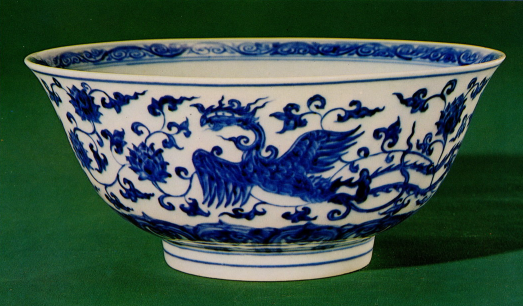
A Chenghua blue-and-white phoenix plate is a quintessential masterpiece of mid-Ming dynasty porcelain. It perfectly embodies the unique aesthetic of the imperial kilns during the Chenghua period (1465-1487), which saw a shift from the bold and heroic style of the Yongle and Xuande eras to a style characterized by lightness, elegance, subtlety, and grace.
Let us conduct a detailed appreciation using a standard piece from the collection of the Museum of Oriental Ceramics, Osaka, as an example.
🎨 Basic Information
| Aspect | Details |
|---|---|
| Name | Blue and White Plate with Phoenixes (with Chenghua mark) |
| Period | Ming Dynasty, Chenghua era (1465-1487) |
| Kiln | Jingdezhen Kiln |
| Dimensions | Height 4.5 cm, Diameter 18.4 cm |
| Weight | 213 g |
| Mark | Six-character reign mark in underglaze blue on the base: “大明成化年制” (Da Ming Chenghua Nian Zhi) |
| Collection | Museum of Oriental Ceramics, Osaka (Ataka Collection) |
Key Points for Appreciation
- 🎨 Elegant Cobalt, Misty and Subtle: The most striking feature of this plate is its blue-and-white color. It uses the specific “Pingdengqing” cobalt ore characteristic of the Chenghua era, which has a lower iron content. When fired, it produces a color that is refined, elegant, clear, and bright, completely devoid of the heavy black iron spots seen in the Yuan dynasty and early Ming (Yongle, Xuande) periods caused by imported “Sumali” cobalt. This subtle blue, complementing the warm body and glaze, creates a unique aesthetic beauty—misty, ethereal, and suggestive—which is considered one of the aesthetic peaks of Ming dynasty blue-and-white porcelain.
- 🎨 Delicate Decoration, Outlined and Filled: The plate’s decoration is exquisitely arranged. A pair of phoenixes is painted in the center and another pair on the exterior wall, surrounded by intricate scrolling treasured flowers (baoxianghua). The phoenix, king of birds, combined with baoxianghua (an idealized auspicious flower), symbolizes good fortune and happiness. The painting technique is a classic example of the “double-line outlining and wash filling” method prevalent during the Chenghua period. Artisans first outlined the delicate, flowing contours with thick cobalt, then filled the outlines with a thinner wash. This technique results in smooth, powerful outlines and a natural, lively composition full of vitality.
- 🏺 Refined Body and Glaze, Smooth as Congealed Fat: Chenghua imperial kilns demanded exceptionally high quality. The clay for this plate was exceptionally finely levigated, resulting in a white, dense body that is thin and elegantly formed. The glaze is uniquely characteristic: thick, lustrous, and smooth as congealed fat. Touching it feels akin to stroking a baby’s skin—warm and moist. If held up to the light, the body subtly reveals a faint pinkish tint, another important identifying feature of Chenghua porcelain.
- ✍️ Distinctive Mark, Gentle yet Strong: The six-character reign mark “大明成化年制” written in underglaze blue on the base in two vertical lines is also key to authentication. Chenghua imperial marks are considered to be the work of one person or a consistent group of scribes. The calligraphic style is largely uniform: the brushwork is natural, appearing soft yet containing strength, both vigorous and gracefully rounded.
Further Reading
Interestingly, behind this seemingly perfect plate lies the incredibly strict quality control of the Chenghua imperial kilns. In 1987, excavations at the Ming imperial kiln site in Zhushan, Jingdezhen, unearthed tens of thousands of porcelain shards from Chenghua-era strata. Research indicates these were intentionally smashed after firing, meaning they were rejects eliminated during court selection. Over 10,000 fragments of foot rings alone were found, highlighting the extraordinarily high quality standards of the time. This surviving, intact phoenix plate is one of the lucky few that passed that rigorous selection.
The Chenghua blue-and-white phoenix plate is not just a beautiful artwork; it is a tangible testament to the changing aesthetic tastes of the mid-Ming dynasty and the strict imperial kiln system.