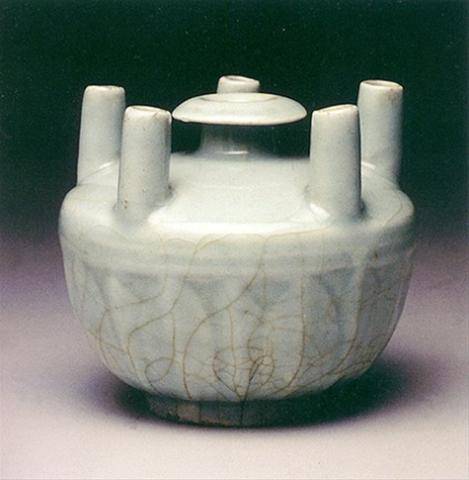


1. Terminology Breakdown
- Southern Song: The dynasty (1127-1279 AD). This was an aesthetic peak in the history of Chinese ceramics. Porcelain from this period pursued a subtle, restrained, and elegant style, winning praise through its glaze color and form rather than complex decoration.
- Longquan Yao (Longquan Kiln): The name of the kiln complex. Located in present-day Longquan City, Zhejiang Province, it was one of the six great kiln systems of the Song Dynasty, renowned worldwide for its jade-like celadon glaze, earning it the title “King of Celadon.”
- Cuiging (翠青): Glaze color description. Refers to a vibrant, emerald-green glaze color, as green as jadeite. This is the classic glaze color developed by the Longquan kilns during the Southern Song period. The glaze layer is thick and lustrous, the color is pure, representing the pinnacle of ancient Chinese celadon glaze beauty.
- Wuguanping (五管瓶 – Five-Spouted Jar): Form name. A distinctive vessel type typically featuring five hollow cylindrical tubes around the shoulder.
2. Form and Function
The Five-Spouted Jar is a special form that originated and was popular in the Zhejiang region. Its function and meaning are debated in academia:
- Mainstream View: Burial Good (Mingqi): It is widely believed that the Five-Spouted Jar (and similar multi-spouted jars or Dragon-and-Tiger jars) was primarily used for burial, functioning as a funerary object (mingqi). The five tubes likely held symbolic meaning, perhaps representing “an abundance of the five grains” (五谷丰登), the “five directions,” or the “five elements” (五行), symbolizing prayers for abundance, peace, and a final resting place for the deceased’s soul.
- Possibility as an Ornamental Piece: A very small number of exceptionally crafted jars with perfect glaze might have been used for display and appreciation, but this is extremely rare.
- Evolution: The form evolved from the Northern Song (960–1127) to the Southern Song. Northern Song jars were often taller with shorter spouts and frequently had finial knobs on the lids. Southern Song examples are more elegantly proportioned, with longer spouts and higher glaze quality.
3. Artistic Features and Value
The “Cuiging Five-Spouted Jar” you described embodies the artistic achievements of the Southern Song Longquan kilns:
- Glaze Color: The “Cuiging” glaze is its soul. The glaze layer is thick, opaque, and has a soft,淡雅 (dànyǎ – serene elegance), warm, and jade-like texture. Achieving this powder-blue or plum-green color required artisans to apply glaze multiple times and precisely control the kiln atmosphere (reduction firing), a process with a very high technical difficulty.
- Form: Southern Song ceramics advocated for natural, elegant, and简约 (jiǎnyuē – simplified) forms. The jar’s shape is stable yet dynamic; the five round spouts create a clever contrast and harmony with the full-bodied jar. The overall lines are fluid and without any superfluous detail.
- Craftsmanship: The entire body is glazed, with only the base of the foot unglazed, revealing the reddish-brown clay body (commonly called “cinnabar base” – 朱砂底 Zhūshā dǐ), a characteristic feature of fine Southern Song Longquan wares. The glaze surface often exhibits fine crackling (crazing), adding to its rustic charm.
4. Market and Collection
A genuine Southern Song Longquan “Cuiging” Five-Spouted Jar is extremely precious. It is a star lot in international top-tier auctions, with prices reaching millions or even tens of millions of RMB.
It is not merely a container but a work of art that encapsulates the wisdom of ancient craftsmen, religious beliefs, and the spirit of its age.