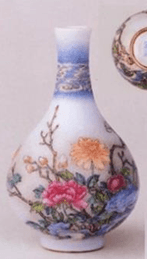
Breakdown of Core Characteristics
- Falangcai (Enamel Painted)
- Status: The ultimate masterpiece among porcelain, often called the “Queen of Overglaze Enamels.” These pieces were fired exclusively for the imperial household in the Palace Workshops (Zaobanchu) of the Forbidden City, making them exceptionally rare.
- Characteristics: The pigments were imported “foreign enamels,” known for their bright, vibrant colors, rich layering, and a glossy, glass-like finish. The painting is exquisitely detailed, often executed by court painters or even European missionaries, resulting in the highest artistic quality.
- Difference from Fencai (Familie Rose): Falangcai enamels are more oily and intense in color, with more precise painting, whereas Fencai appears softer and more powdery.
- Rouge de Cuivre (Familie Rose, specifically a pinkish-purple)
- Color: A pinkish-red with a distinct purple undertone, as radiant as rouge, hence its name. It is an overglaze color fired at a low temperature, using gold as the coloring agent—a precious pigment introduced from the West during the late Kangxi period.
- Significance: During the Qianlong era, Rouge de Cuivre was extensively used in Falangcai ware. Its ability to create subtle gradients was perfect for expressing depth and dimensionality in paintings, making it highly decorative.
- Landscape Painting
- Subject Matter: This involves translating the tradition of Chinese ink wash landscape painting onto porcelain. The Qianlong Emperor, deeply versed in Han Chinese culture, had a particular fondness for the landscape styles of the Song, Yuan, and Ming masters.
- Style: These landscape scenes are typically meticulously composed, with refined brushwork that employs classic texturing strokes (cunfa). They evoke a sense of serene distance and possess a distinct scholarly elegance, often accompanied by inscribed poems and seals, essentially forming a miniature painting on porcelain.
- Small Vase
- Form: The term “small vase” indicates a modest size, likely in an elegant and delicate form such as a “gall bladder vase,” “olive vase,” or “Guanyin vase.”
- Function: Such small vases were not utilitarian but purely for display and scholarly appreciation, perhaps used for holding a single, delicate flower branch. They are a classic example of the Qianlong Emperor’s refined taste for “elegant pastimes” (Yawan).
Artistic and Historical Value
- Pinnacle of Craftsmanship: A single object that combines the finest white porcelain body (typically fired in the Jingdezhen imperial kilns), the masterful painting skills of court artists, and the expert firing techniques of the Palace Enamel Workshop. It represents the highest technical achievement of Qianlong imperial porcelain.
- A Fusion of East and West: The Rouge de Cuivre pigment originated in the West, while the landscape theme and painting technique are purely Chinese, perfectly illustrating the cultural exchange during the Qianlong era.
- Embodiment of Imperial Taste: The Qianlong Emperor favored an aesthetic that was intricate, refined, and opulent. This small vase, with its gorgeous colors and exquisite painting, directly reflects his “perfecting the finest details” approach.
Market and Collection
- Rarity: Genuine Qianlong Falangcai porcelain is exceptionally rare worldwide. The vast majority are housed in the Palace Museums in Beijing and Taipei. Pieces that appear on the open market are few and far between.
- Value: When such pieces appear in top-tier auction houses, they command astronomical prices. For instance, similar objects (like Qianlong Falangcai “Guyuexuan” inscribed bowls or vases) have repeatedly sold for hundreds of millions of Hong Kong dollars, making them “blue-chip” assets in the art market.
Appreciation and Authentication
Given their immense value, the market is flooded with imitations. Key points for appreciation and authentication include:
- Porcelain Body: Genuine pieces have a light, fine, and smooth body, perfectly potted. When held to the light, the body has a warm, ivory-white glow.
- Enamels: The Rouge de Cuivre color should be pure and natural, with smooth gradients and a soft, luminous surface sheen.
- Painting Quality: The landscape painting requires a master’s hand. The brushwork should be fluid, the rocks and trees should show expert texturing strokes, and any figures, though tiny, should be vivid.
- Inscriptions and Seals: The poems should harmonize with the painting’s theme, and the calligraphy must be excellent. The seals, such as the “Qianlong Nian Zhi” mark, are typically square, enameled marks with neat characters, often within a border.
- Overall Aura: Authentic pieces possess an inherent “brilliance” and a majestic, imperial elegance that is very difficult to replicate. Fakes often appear stiff, garish, or overly mechanical.
In summary, the “Qianlong Falangcai ‘Rouge de Cuivre’ Landscape Small Vase” you described is a masterpiece that fuses supreme craftsmanship, imperial taste, and scholarly refinement. It is not only a testament to the technical prowess of the Qianlong Golden Age but also an enduring monument in the history of Chinese ceramic art.