


The pottery-making techniques of the Western Zhou and Spring and Autumn periods advanced significantly from those of the Shang Dynasty. In terms of shape and decoration, pottery and bronze vessels of this time influenced and enriched each other.
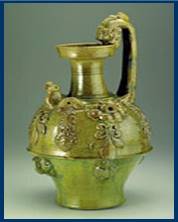
1. “Glazed” – A Major Technological Advancement
- The glaze here likely refers to the lime glaze used in primitive celadon porcelain. This technique emerged during the Shang and Zhou dynasties and matured during the Spring and Autumn and Warring States periods.
- Artisans applied a glaze made from lime and clay to the surface of the pottery. When fired at high temperatures, it formed a smooth, transparent, and glossy glass-like layer.
- Significance: This glaze not only enhanced the visual appeal of the vessel, giving it a greenish or yellowish-green hue, but also sealed the pottery’s pores, making it more durable, waterproof, corrosion-resistant, and easy to clean. Its practical functionality was greatly improved. This was a critical step in the evolution from “pottery” to “porcelain” in ceramic history.
2. “Chicken Head and Chi-Dragon” – Exemplary Design and Decoration
- Chicken Head: The use of a realistic or exaggerated chicken head as the spout (for pouring) was a popular design in the Spring and Autumn period. Chickens symbolized “auspiciousness” and ” heralding the dawn” in ancient times, while also reflecting artistic inspiration drawn from everyday life.
- Chi (Chi-Dragon): The chi is a mythical hornless dragon in ancient legends, often used as a decorative motif on bronze vessels. On this pottery pot, the “chi” likely refers to the handle shaped like a chi-dragon or chi-dragon patterns carved on the body of the pot.
- Combination of Elements: The “chicken-head spout and chi-dragon handle” was a classic design for pots during the Spring and Autumn period. The vivid realism of the chicken head contrasted with the mystical elegance of the chi-dragon, creating a striking visual and artistic tension.
3. “Pottery Pot” – Function and Status
- Such exquisitely crafted pottery, adorned with glaze and intricate sculptures, was far from ordinary daily ware for commoners. It was likely produced for the noble class, used in banquets, rituals, or as burial objects. Its existence indicates that high-quality pottery could, to some extent, serve as a substitute or complement to expensive bronze vessels during this time.
Mutual Influence Between Pottery and Bronze Vessels
- Pottery Imitating Bronze Vessels:
- Shape: Designs like chicken-head pots and beast-head ring handles were first commonly seen on bronze vessels. Potters borrowed these popular elements from bronze ware and reinterpreted them using clay.
- Decorations: Patterns such as chi-dragon纹, panchi纹 (interlaced hydra patterns), and qiequ纹 (abstract curvilinear patterns) were mainstream motifs on bronze vessels of the same period. Their use on pottery aimed to emulate the nobility and elegance of bronze ware.
- Innovations in Pottery and Their Feedback:
- With lower production costs and more flexible techniques, pottery dared to experiment with more realistic and lifelike themes (e.g., chicken heads). These successful innovations may have, in turn, inspired bronze vessel designs.
- The successful application of primitive porcelain glaze laid a solid foundation for the great development of ceramics in the Warring States, Han, Tang, and Song dynasties. This technological path was unique to pottery and not seen in bronze craftsmanship.
The “Glazed Pottery Pot with Chicken Head and Chi-Dragon Design” is a highly representative artwork of the Spring and Autumn period. It is not only a practical container but also an exquisite sculpture, serving as an important historical artifact that witnesses the breakthrough development of pottery techniques and the mutual enrichment between pottery and bronze cultures.
