

Terminology Breakdown
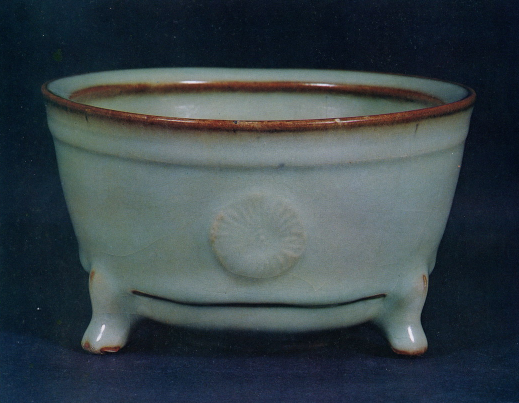
- Southern Song Guan Kiln: Refers to the official kilns established during the Southern Song dynasty (such as the Jiaotanxia or Xiuneisi Guan Kilns), which produced ceramics exclusively for the imperial court. Key characteristics include lustrous glazes (often in shades of fenqing “powder blue,” grey-blue, or beige), intentional and natural crackle patterns (e.g., “ice crackle” or “crab claw crackle”), relatively thin bodies, and a dark grey or iron-colored clay (“purple mouth and iron foot”).
- Appliqué : A decorative technique involving separately molded or hand-sculpted ornamental motifs (such as animal masks (pushou), coiled dragons, or flowers) that are attached to the leather-hard body using slip before glazing and firing. This creates raised, three-dimensional decoration with a classical elegance.
- Censer : An incense burner, a significant category within Song dynasty ritual and scholarly implements. Southern Song Guan kilns produced various classic censer forms, including li-style, gui-style, ding-style, and lian-style.
Craftsmanship and Artistic Characteristics (Based on an Appliqué Censer Model)
- Form: Typically features archaic, dignified, and balanced forms, often drawing inspiration from Shang-Zhou bronze or ancient jade shapes, reflecting the Song literati’s revivalist tastes. The body may be cylindrical, tripod-based (ding), or barrel-shaped (lian).
- Appliqué Motifs: Common decorative elements include:
- Animal Masks (Pushou) with Rings: Imitating archaic bronzes, applied symmetrically on the body, conveying authority and solemnity.
- Coiled Dragon (Panchi) and Kui Dragon Patterns: Stylized, archaic motifs symbolizing power and auspiciousness.
- Floral Reliefs: Such as plum blossoms or peonies; less common and indicative of refined craftsmanship.
- Glaze and Crackle: Covered overall with a thick, jade-like glaze. The prized color is a soft “powder blue.” The glaze surface exhibits a network of natural, intersecting crackles of varying depth, considered an aesthetic feature.
- Body and Foot: The clay body is typically dark grey or black. Unglazed foot rims oxidize to a dark brown or iron hue during firing (“iron foot”). The thin glaze at the mouth rim reveals the dark body beneath, creating a subtle “purple mouth” effect.
- Technical Challenge: The appliqué technique requires the body clay and the appliqué pieces to have matching shrinkage rates during firing. Otherwise, they may separate or cause cracking, leading to a high failure rate and greater rarity for successful pieces.
Relevant Museum Collection References
While precise “Appliqué Censers” from Southern Song Guan kilns are extremely rare, the following related pieces provide important context:
- Northern Song, Ru Ware, Celadon Censer with Molded Dragon Decoration (National Palace Museum, Taipei): Uses a similar molded appliqué technique for a dragon motif, representing the pinnacle of Northern Song celadon and a technical precursor.
- Southern Song, Longquan Kiln, Celadon Censer with Appliqué Dragon Design: Longquan wares, influenced by Guan ware, also produced appliqué-decorated censers, offering parallels in form and technique.
- Southern Song, Guan Ware, Celadon Ding-Style and Li-Style Censers (e.g., Palace Museum, Beijing; National Palace Museum, Taipei): While lacking appliqué, these exemplify the classic forms, glaze qualities, and “purple mouth, iron foot” trait of Guan ware censers.
Critical Considerations
- Extreme Rarity: Authentic Southern Song Guan ware is exceptionally rare. Complete vessels with complex appliqué decoration are among the rarest. Any appearance on the market warrants extreme caution and rigorous verification.
- Proliferation of Imitations: Imitations were produced in later dynasties (Ming, Qing) and continue to be made today. Appliqué censers are a frequently copied model. Authentication requires careful analysis of material, glaze texture, crackle patterns, craftsmanship details, and foot treatment.
- Scholarly Discourse: Archaeological understanding of specific Southern Song Guan kiln sites (like Xiuneisi) is still evolving. Definitive attribution often requires support from archaeological context and scientific analysis.
Summary
The Southern Song Guan Kiln Appliqué Flower-Decorated Censer represents a zenith of Song ceramic art:
- It synthesizes imperial refinement, a revivalist aesthetic, masterful ceramic technology (controlled thick glazes and crackles), and intricate decorative artistry (appliqué).
- It functioned not only as a utilitarian incense burner but also as a ritual vessel and object of scholarly contemplation, embodying the cultural and artistic ideals of the Song dynasty.