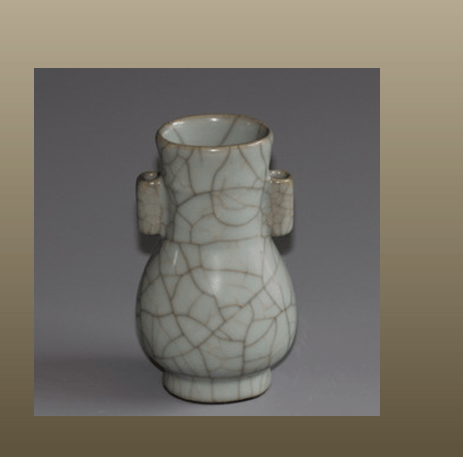
:Modeled after the ceremonial arrow vases of the Han Dynasty, this vase features a long neck and varied belly shapes, including octagonal, rounded, or flattened forms, with a ring foot. Its defining characteristic is the pair of tubular handles (“guan’er”) attached to either side of the neck. First appearing in the Song Dynasty, it remained popular through the Ming and Qing periods.
(Note: “Guan’er” literally means “pierced ears,” referring to the tubular handles. The translation “Tube-Eared Vase” preserves the original term while making it understandable to English readers. An alternative could be “Double-Tube Vase” or simply retaining “Guan’er Vase” with explanation.)