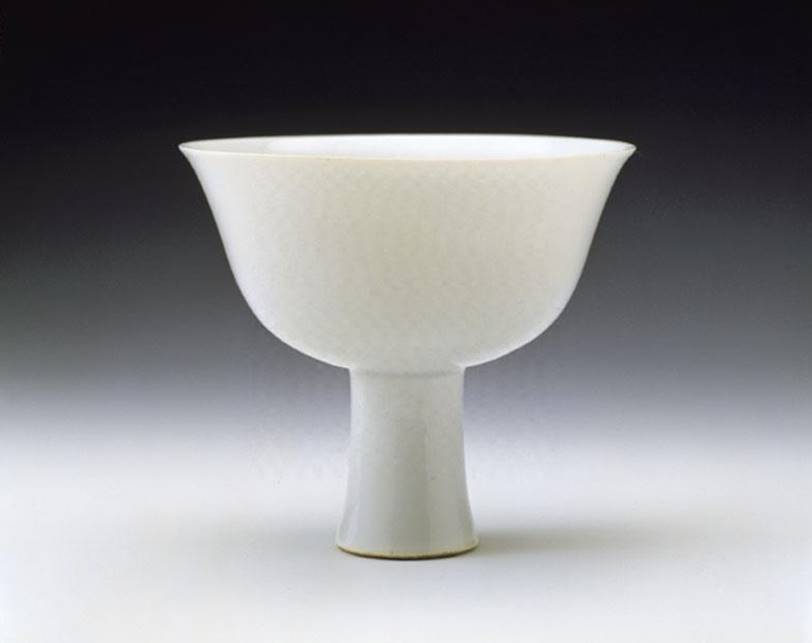
- Form: Elegant, Rounded, and Refined
- Spirit of the Era: This reflects the shift in aesthetic taste from the monumental and robust style of the Yuan Dynasty to the exquisite and elegant style of the Yongle period. The pieces feature smooth, flowing lines and graceful silhouettes, winning praise through their dignified and lively forms rather than complex shapes.
- Typical Shapes: These include monk’s cap ewers, handled ewers, stem cups, dishes, bowls, jars, and libation cups (jue). Many shapes show strong influences from Islamic metalwork, indicating frequent cultural exchanges at the time.
- Body: Slightly Thick, Unglazed Foot, White and Fine
- Reason for “Slightly Thick”: Compared to the “thin as a cicada’s wing” body of later Chenghua porcelain, the body of Yongle Sweet White is indeed somewhat thicker. However, this is a refined solidity, ensuring the stability of the object at high firing temperatures and imparting a sense of sturdiness.
- Craftsmanship of “White and Fine”: This results from the Jingdezhen potters’ selective refining of kaolin and porcelain stone. Impurities in the clay were minimized, making the body appear pure creamy-white even in unglazed areas (especially the foot), with an exceptionally fine texture that feels smooth and slightly sticky.
- Glaze: Thick, Luminous, and Slightly Bluish at the Foot
- Origin of the “Sweet White” Name: The thick, glossy glaze is the core of the “Sweet White” sensation. This glaze contains very low iron and was fired in a controlled kiln atmosphere, producing a slight sugary sweetness and a warm, jade-like quality, rather than a pure, harsh white.
- Reason for the “Slightly Bluish” Tinge: This is an important period characteristic of Yongle Sweet White. Because the glaze is thick, at the edges or where it pools (e.g., near the foot), light passing through the glaze reveals a subtle, hidden bluish-green tint within the white, similar to the quality of mutton-fat jade. This adds depth and complexity to the glaze color.
- Base Mark: Both Unmarked and Marked Examples; Marks are Four-Character Seal Script
- A Pioneering Act: Yongle Sweet White glaze was among the first imperial porcelains to bear an official reign mark.
- “Yongle Nian Zhi” Four-Character Seal Script Incised Mark: The mark was typically incised or molded on the center of the interior or the inner wall, not on the base. The characters are standard seal script, clear and structured, but extremely faint and difficult to see. The thick glaze covers the incised mark, making it visible only under specific lighting angles, hence the saying, “The Yongle mark is precious, invisible to the eye, but felt by the touch.”
- Most are Unmarked: The vast majority of Yongle Sweet White pieces are unmarked. Their attribution relies on a comprehensive assessment of their distinctive body, glaze, and form.
Artistic and Historical Value
- The Pinnacle of White Porcelain Art: Yongle Sweet White glaze represents the highest achievement in the firing of ancient Chinese white porcelain. It is not merely a ‘blank canvas’ for decoration; its jade-like glaze is a complete and ultimate art form in itself.
- Product of Technical Innovation: Its success stemmed from the Yongle Emperor’s personal preference for white porcelain, the discovery of superior body and glaze recipes, and the strict production standards of the imperial kilns. It provided the purest and most ideal “canvas” for the development of later painted porcelains like Doucai and Wucai.
- Embodiment of Imperial Character: This pure, flawless, and jade-like quality aligned with the Chinese scholarly class’s pursuit of virtuous character and reflected the Yongle era’s imperial art’s pursuit of ultimate purity and elegance.