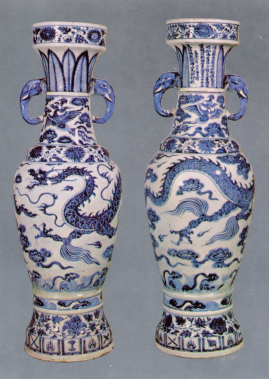
1. Basic Background
- Period: Yuan Dynasty (mid to late 14th century, particularly typical of the Zhizheng era).
- Purpose: Originally used as ritual vessels, likely for temple or aristocratic ancestral hall offerings.
- Current Status: The only known pair of large Yuan Dynasty blue-and-white vessels with dated inscriptions. Originally housed in the Zhihua Temple in Beijing, they later made their way overseas and are now in the British Museum.
2. Form and Decorative Features
- Shape:
- Approximately 63 cm in height, large and imposing with a dignified form.
- Features a dish-shaped mouth, long neck, broad shoulders, a full belly, and a tall ring foot.
- The neck is adorned with elephant-head handles, each holding a ring in its trunk, symbolizing auspiciousness (“peace and prosperity represented by the elephant”).
- Layout of Decoration (eight tiers from top to bottom):
- Neck: Chrysanthemum scrolls, banana leaf patterns, flying phoenixes, etc.
- Main Body (belly): Cloud and dragon patterns (e.g., double dragons chasing a pearl or dragons soaring through clouds). The dragons are vigorous, typically with three or four claws, characteristic of Yuan Dynasty dragon motifs.
- Other Areas: Auxiliary patterns such as lotus scrolls, sea waves, and miscellaneous treasures, densely arranged with clear layers.
- Blue-and-White Coloring:
- Uses imported “Sumali” cobalt, producing rich, vibrant hues with silvery-black speckles and a slightly sunken appearance in deeper areas.
3. Inscriptions and Key Dating Evidence
- Neck Inscriptions:
Each bottle bears a 62-character inscription on the neck, recording:- Dedication date: Zhizheng 11th year (1351).
- Donor: The Zhang Wenjin family from Yushan County, Xinzhu Road (present-day Shangrao, Jiangxi).
- Purpose: Offered to a Daoist temple to pray for family safety and children’s well-being.
- Significance:
- The dated inscription makes this pair a “benchmark” for authenticating Yuan Dynasty blue-and-white porcelain, often referred to as “Zhizheng-type blue-and-white” in academia.
- Confirms that blue-and-white porcelain had reached its technical and artistic peak in the late Yuan Dynasty and was closely linked to folk beliefs.
4. Provenance and Research History
- Early 20th-Century Discovery:
Originally kept in Beijing’s Zhihua Temple, they were later acquired by the British collector Sir Percival David, hence also known as the “David Vases.” - Academic Value:
In the 1950s, American scholar John Pope used this pair as a reference to compare blue-and-white pieces in Iran and Turkey, establishing a systematic framework for authenticating Yuan Dynasty blue-and-white porcelain. - Current Status:
Permanently displayed in the British Museum’s “Sir Percival David Collection” gallery, regarded as one of the museum’s crown jewels in Chinese ceramics.
5. Artistic and Historical Significance
- Technical Achievement:
Demonstrates the advanced skills of Jingdezhen kilns in firing large vessels, painting with blue-and-white, and controlling cobalt materials during the Yuan Dynasty. - Cultural Fusion:
The combination of dragon motifs with Daoist inscriptions reflects multicultural integration, while the elephant-head handles show Buddhist artistic influences, highlighting the international character of Yuan Dynasty craftsmanship. - Impact on Market and Authentication:
Due to their uniqueness, no similar works have appeared in the global auction market, making them a crucial reference for authenticating Yuan blue-and-white porcelain.
6. Frequently Asked Questions
- Are They Unique?
Yes, no other Yuan Dynasty blue-and-white elephant-head vases with identical inscriptions and form are known to exist. - Why Are They Overseas?
During the turbulent early 20th century in China, many cultural relics were exported through antique dealers, and this pair is a classic example. - Modern Reproductions:
Numerous imitations exist on the market, but genuine pieces exhibit natural cobalt speckling, heavy body, and a glossy glaze. Reproductions often fail to replicate the characteristics of Sumali cobalt or the historical patina.
Summary
The Yuan Dynasty blue-and-white dragon-design elephant-head vases are not only masterpieces of Yuan ceramic art but also chronological benchmarks in Chinese cultural history. They bear witness to the brilliance of Jingdezhen kilns during the Yuan Dynasty and carry the history of cultural relics’ displacement in modern times. As such, they serve as a vital bridge for academic research and cultural dialogue between East and West.