Core Features and Value
- Form (Meiping):
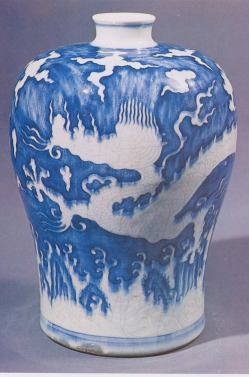
- Standard Yongle Style: Possesses all the virtues of a Yongle Meiping—small mouth, short neck, full shoulders, a slender body that tapers slightly, and a slightly flared lower section. Its lines and proportions are exceptional: upright, dignified, and containing a latent dynamism within its static form, perfectly complementing the vigorous dragon motif.
- Body, Glaze, and Blue Pigmentation:
- Superior Body and Glaze: Exemplifies Yongle imperial ware characteristics. The body is fine, pure white, and lightweight yet perfectly formed. The glaze is thick, lustrous, and smooth, with the typical “sweet white” tone, providing a jade-like canvas.
- Cobalt Brilliance: Uses premium “Sumali” cobalt. The color is intense, sapphire-like. Due to the pigment’s properties, areas where the cobalt pooled—such as dragon scales and outlines—show deep, rust-colored iron oxide spots and a metallic sheen, with natural diffusion. This creates an ethereal quality, making the dragon appear to surge through clouds, combining solid form with misty void for a majestic effect.
- Decoration (Cloud and Dragon Design):
- Primary Dragon Motif:
- Form: Yongle dragons are highly distinctive. The head is large and full, with round, glaring eyes. The mane flows dramatically upward or forward like flames, known as the “Yongle vertical-mane dragon.” The body is robust and powerful, with strong limbs and sharply defined, spoked five-clawed feet.
- Posture: Typically depicted as a prancing dragon, it coils around the body of the vase, galloping through a sea of clouds. The sense of movement is powerful, brimming with fierce, vibrant energy.
- Auxiliary Cloud Patterns: The clouds are called “wenzi-style clouds” or “ruyi-head clouds.” They feature plump heads and long, slender, curling tails that weave around the dragon, highly decorative and dynamic. The combination perfectly realizes the imperial theme of the “dragon soaring through the heavens.”
- Composition: The curved surface of the Meiping required masterful design to ensure the dragon and clouds formed a harmonious and complete image from every viewing angle, showcasing the imperial painters’ superb compositional skill.
- Primary Dragon Motif:
- Technical Details:
- Usually has a fine, smooth, flat sand-finished base, occasionally with faint “fire-rust” red spotting. Such significant vessels often bear no reign mark, relying instead on the quality of body, glaze, form, and painting for authentication—a hallmark of top-tier “unmarked” Yongle imperial wares.
Historical Context and Symbolic Meaning
- Symbol of Imperial Power: The dragon, especially the five-clawed dragon, was an exclusive symbol of the emperor’s supreme authority in the Ming Dynasty. This Meiping was not for daily use but served as imperial display or ritual ware, designed to project the majesty of the throne and the Mandate of Heaven.
- Artistic Pinnacle: This vessel synthesizes the pinnacle of ceramic technology and painting art of the Yongle period. The vibrancy of Sumali blue, the warmth of the sweet white glaze, the elegance of the Meiping form, and the ferocity of the cloud-dragon motif achieve a harmonious unity, a classic fusion of power and beauty.
- Connecting Past and Future: While inheriting the ferocity of Yuan dynasty dragons, the Yongle dragon became more standardized, patterned, and aesthetically decorative, establishing the fundamental model for Ming imperial dragon motifs with far-reaching influence.
Preservation and Collection
The Yongle blue-and-white Cloud and Dragon Meiping is an exceedingly rare masterpiece of imperial porcelain, housed in the world’s top museums and important collections, such as:
- The Palace Museum in Beijing and the National Palace Museum in Taipei.
- Similar pieces are also found in major international institutions like the British Museum and the Victoria and Albert Museum, where they are often considered centerpiece exhibits.
In summary, the Yongle Blue-and-White Cloud and Dragon Meiping is a jewel in the crown of Yongle imperial blue-and-white porcelain. It represents not only the absolute zenith of ceramic technology of its time but also the material embodiment of early Ming imperial ideology and aesthetic ideals. Its powerful dragon, bold brushwork, and elegant form together constitute a timeless artistic masterpiece, holding a pivotal position in the history of Chinese ceramics.