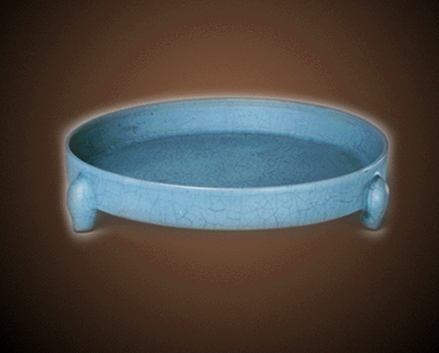
The Three-Legged Washer (三足洗) in Chinese Ceramics
The “Three-Legged Washer” (Sān Zú Xǐ) is a classic and significant form in ancient Chinese ceramics. Below is a detailed introduction.
What is a Three-Legged Washer?
A Three-Legged Washer is, as the name implies, a water vessel supported by three legs. The “Washer” (Xǐ) was an ancient toiletry utensil, functionally similar to a modern basin or bowl, used for holding water to wash hands. The legs elevate the vessel, giving it a dignified appearance and making it more practical.
Its form originally appeared in bronze vessels from the pre-Qin period (before 221 BCE), which were later imitated by ceramic artisans. It gradually evolved into an important Scholar’s Object (文房用具) during the Song, Ming, and Qing dynasties.
Key Characteristics
- Shape: Typically a compressed spherical, bowl-like, or shallow dish form with a wide mouth and a shallow body, supported by three short legs.
- The Three Legs: The legs come in various shapes, commonly:
- Beast Hoof Feet: Resembling the sturdy hooves of an animal.
- Ruyi-Head Feet: Shaped like the head of a Ruyi scepter (a symbolic ornamental object), highly decorative.
- Cylindrical Feet: Simple, pillar-like legs.
- Evolution of Function:
- Early Period: A practical washing vessel.
- Song Dynasty Onwards: Primarily used as a Scholar’s Object, specifically a Brush Washer (笔洗), for rinsing writing brushes. By this time, its practical function diminished, and it became more of an elegant object for display on a scholar’s desk, reflecting the aesthetic taste of the literati.
Famous Historical Examples (by Kiln/Dynasty)
1. Song Dynasty – The Pinnacle of Artistry
The Song Dynasty represents the peak of ceramic art, and the Three-Legged Washer reached an apex of aesthetic and technical perfection during this period, especially those from the Ru and Ge kilns.
- Ru Ware Three-Legged Washer
- Characteristics: Ru Ware was the foremost of the “Five Great Kilns” (Ru, Guan, Ge, Jun, Ding) of the Song Dynasty, producing exclusively for the imperial court. Its glaze color is Sky-Blue (天青色), a soft, serene, and opalescent blue-green hue, often described as “the sky after rain.” The glaze has a moist, jade-like luster with fine crackles (known as “ice crackle”).
- Status: Extremely few Ru Ware pieces survive today (fewer than 100 are公认), making each one a national treasure. The Palace Museum in Beijing houses a famous “Sky-Blue Glazed Three-Legged Washer,” considered a crown jewel of its collection.
- Ge Ware Three-Legged Washer
- Characteristics: The most distinctive feature of Ge Ware is its crackle (开片), the network of cracks naturally formed in the glaze. This intentional exploitation of a technical “flaw” was appreciated by scholars for its unique beauty, termed “Golden Threads and Iron Wires” (金丝铁线). Typically, larger cracks are dark brown or black (“iron wires”), while smaller ones are golden yellow (“golden threads”), creating an intricate, antique pattern.
- Status: Ge Ware is highly revered for its distinctive “flawed beauty” and its simple, profound texture.
2. Qing Dynasty – Archaism and Innovation
During the Qing Dynasty, especially under the emperors Kangxi, Yongzheng, and Qianlong, archaism was in vogue. The Three-Legged Washer was widely copied and innovated upon, with techniques pursuing complexity and refinement.
- Jingdezhen Ware Three-Legged Washer
- Imitation Ru/Ge Glazes: The imperial kilns at Jingdezhen successfully replicated the Ru sky-blue glaze and the Ge crackle glaze, often marking them with the reign mark of the current emperor (e.g., “Made in the Great Qing Yongzheng Reign”).
- Monochrome Glazes and Overglaze Enamels: New varieties emerged, such as Three-Legged Washers in Flambé Glaze (炉钧釉) or Tea-Dust Glaze (茶叶末釉), as well as those decorated with Blue-and-White (青花) or Famille Rose (粉彩) enamels. The forms and decorations became much more diverse.
Collection and Value
- Song Dynasty Three-Legged Washers: Particularly those from the Ru, Guan, and Ge kilns, are museum-grade pieces of extremely high market value. They rarely appear in private circulation, and when they do, they command astronomical prices.
- Ming and Qing Dynasty Three-Legged Washers: These are more commonly found in the art market. Their value depends on the kiln, dynasty, condition, and craftsmanship. Exquisitely made imperial pieces, especially from the Kangxi, Yongzheng, and Qianlong reigns, are highly valuable.
Conclusion
The Three-Legged Washer evolved from a practical bronze vessel form into a representative of Song minimalist aesthetics, and further into an elegant object on the desks of Ming and Qing literati. It runs through the development of Chinese ceramic history. It is not merely an object but a vessel carrying the rituals, culture, and aesthetic tastes of ancient China.
- The Song Dynasty Three-Legged Washer represents the pinnacle of classical aesthetics: reserved, introverted, and naturally elegant.
- The Ming and Qing Three-Legged Washer embodies the technical mastery, archaism, and innovation of courtly taste.