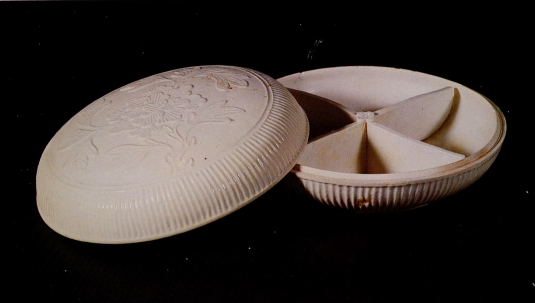
1. Analysis of Core Characteristics
Kiln and Body/Glaze – “Dehua Kiln”
- Origin: Located in Dehua, Fujian, it is one of China’s most famous white ware kilns, renowned globally in the Ming and Qing dynasties for its “ivory white” and “lard white” porcelain sculptures. The Yuan Dynasty was a crucial period for its maturation.
- Body: The body of Yuan Dehua ware is slightly thicker and coarser compared to Ming and Qing pieces, but the clay was already quite refined, resulting in a body color that is white with a hint of grey or pale yellow.
- Glaze: The glaze layer is thicker than that of Song Dynasty wares. The glaze color is primarily a bluish-white (“qingbai”) or an early, somewhat opaque version of the “lard white.” The glaze surface is warm and has a soft luster.
Decoration – “Peony Pattern”
- Form: The peony pattern typically serves as the primary decoration, applied to the lid of the box using molding or carving techniques. The composition is lush and full, with large, showy flowers and luxuriant leaves, full of vitality.
- Cultural Significance:
- Symbol of Wealth and Status: Since the Tang Dynasty, the peony has been honored as the “King of Flowers,” symbolizing wealth, prosperity, and good fortune. This meaning remained highly popular during the Yuan Dynasty.
- Period Style: The decorative style of the Yuan Dynasty tended towards complexity and realism. The peony motifs are rich in layers, finely detailed, and more naturalistic, contrasting with the subtle lotus petal patterns of the Song Dynasty.
Form and Function – “Box”
- Form: This type of “box” typically refers to a small, squat circular lidded box with a interlocking rim (“zimu kou”). Its shape is regular, with a flat lid suitable for displaying a complete decorative pattern.
- Function: Such boxes had a wide range of uses. They could hold cosmetic powder and rouge for women, serve as seal paste boxes, or function as containers for spices or medicine. They were not only utilitarian objects but also refined articles for the dressing table.
2. Craftsmanship and Historical Context
- Manufacturing Process: The primary techniques were molding and carving. The molding process resulted in clear, regular patterns suitable for mass production, reflecting the increased commercialization of porcelain in the Yuan Dynasty. Artisans pressed carved molds onto the unfired body to create raised patterns before glazing and firing.
- Historical Context: With the flourishing of overseas trade during the Yuan Dynasty, Dehua ware became an important export commodity. Its decorative style was influenced by market demands, becoming more distinct and prominent to cater to diverse cultural aesthetics.
3. Artistic and Collectible Value
The Yuan Dynasty Dehua Kiln Peony Pattern Box holds significant historical and artistic value:
- A Bridge Between Eras: It forms a crucial link between the Song Dynasty Dehua ware and the peak period of Dehua production in the Ming and Qing dynasties, illustrating the evolution of Dehua white porcelain craftsmanship.
- Integration of Life and Art: It perfectly combines auspicious symbolism with daily use, reflecting the rise of urban culture and the prosperity of practical arts in the Yuan period.
- Scarcity: Intact Yuan Dynasty Dehua porcelain is far rarer than pieces from the Ming and Qing periods, thus granting it higher collectible value.
The Yuan Dynasty Dehua Kill Peony Pattern Box, with its white body and glaze, lush and luxurious peony decoration, and exquisite, practical form, demonstrates the innovative development of Dehua Kiln porcelain within its inherited traditions. Unlike the Song Dynasty Yingqing ware, which sought a subtle, jade-like quality, this piece uses a more direct and vivid decorative language to express people’s aspirations for a prosperous life. It is an important artifact for studying the production of Yuan folk kilns, social life, and aesthetic tastes.