Basic Concepts
Washer: A type of scholar’s object used to hold water for rinsing brushes or diluting ink, similar to a small water pot or brush washer.
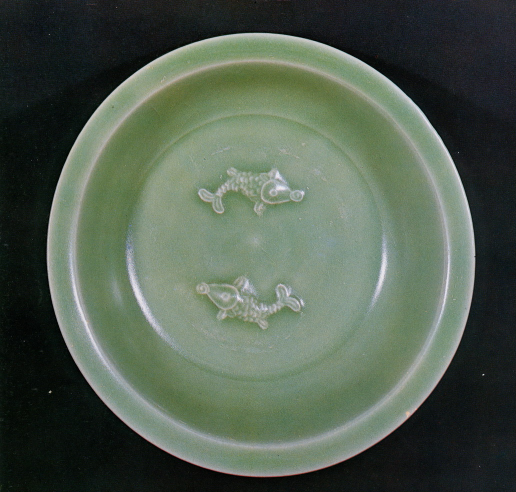
Double-Fish : Refers to the two fish motifs applied or carved on the interior base, which is the defining decorative feature of this type of vessel.
Longquan Kiln: A famous historic Chinese celadon-producing kiln complex located in Longquan, Zhejiang province. It began production in the Northern Song period and reached its peak from the Southern Song through the Yuan dynasty, renowned worldwide for its jade-like green glazes.
Core Characteristics
A typical Southern Song Longquan Double-Fish Washer exhibits the following features:
Glaze Color: Fenqing (Powder-Green) or Meiziqing (Plum-Green) Glaze. This represents the pinnacle of Southern Song Longquan technology.
Fenqing: Thick, lustrous glaze with a color that is bluish-green with a soft, opaque, powdery quality, reminiscent of the sky after rain. The texture is like congealed fat.
Meiziqing: A vibrant, translucent green resembling the color of a ripe plum, with a stronger glassy luster.
The glaze quality typically possesses a “jade-like” texture, embodying the highest aesthetic ideal of the Song dynasty.
Form: Most commonly with a wide, flared mouth, shallow rounded sides, and a ring foot. The shape is simple, elegant, and harmonious, with smooth, rounded lines that perfectly reflect the minimalist and refined Song aesthetic.
Decoration:
Double-Fish Motif: Located centrally on the interior base. The most common technique is appliqué.Clay fish shapes were pressed from molds, then applied to the leather-hard body before the thick glaze was added. Firing resulted in plump, three-dimensional fish seemingly swimming beneath the glaze. Incised fish motifs also exist but are less iconic.
Fish Types: Usually carp or mandarin fish, symbolizing “abundance year after year”and “wealth and nobility”. The pair of fish swimming together also symbolizes harmony and good fortune.
Other Decoration: The rim or exterior may sometimes feature raised ridges or have simple incised water waves under the glaze to complement the fish.
Craftsmanship:
Employed a thick-glaze technique involving multiple glaze applications, resulting in a dense, lustrous, jade-like surface.
The body (biscuit) is a greyish-white, fine-grained clay.
Fired at high temperatures in a reduction atmosphere in a dragon kiln, a technologically demanding process.
Historical & Cultural Value
Historical Context: Such Double-Fish Washers are classic products of the Southern Song period, reflecting the demand for refined scholar’s objects and the aesthetic taste of the imperial court, literati, and elite society.
Cultural Meaning: The fish motif is a traditional Chinese symbol of auspiciousness. The double fish served not only a functional purpose (perhaps indicating water level) but also imbued the object with the blessing of “abundance and celebration,” perfectly combining utility, artistry, and symbolism.
Artistic Status: Represents one of the highest achievements of Song Dynasty Longquan celadon art. It is a perfect embodiment of the Song aesthetic philosophy of “subtlety, restraint, naturalness, and elegance.”
Collecting & Authentication Points
Authentic Pieces: Pure, thick, and lustrous glaze with a soft, inner glow (not a harsh, shiny “neon” light). The fish are shaped with a naive vitality and natural composition. Unglazed areas on the foot ring show natural oxidation . The foot ring is neatly trimmed.
Later Imitations: Copiously reproduced in the Ming, Qing dynasties, and modern times. Imitations often have glaze that is too uniformly bright (or conversely, dry and dull), stiff and formulaic fish motifs, and a body that is too white or heavy, lacking the ancient “spirit.”
Market Value: Song Dynasty Longquan Double-Fish Washers are highly sought-after in the international collectors’ market. Examples in excellent condition with superior glaze can reach prices from hundreds of thousands to several million RMB or even higher at top-tier auction houses.
Summary
The Song Dynasty Longquan Kiln Double-Fish Washer is far more than a utilitarian scholar’s object. It is:
A crystallization of Song Dynasty aesthetics (jade-like quality, minimalist form).
The pinnacle of Longquan Kiln technology (thick glaze, fenqing/meiziqing glazes).
A vehicle for auspicious culture (double-fish symbolism).
A reflection of literati life (a refined object for the scholar’s studio).