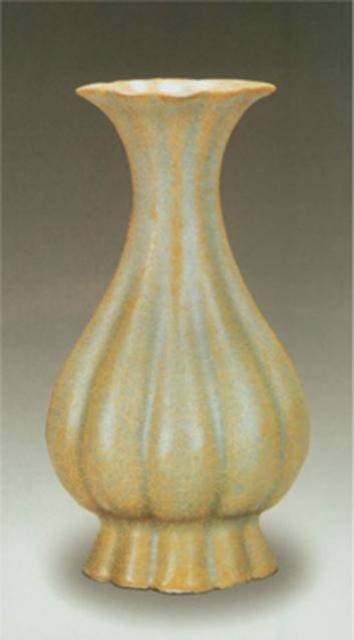
1. Basic Information & Background
- Kiln:Jiaotanxia Guanyao (Imperial Kiln)
- This was the official kiln established by the Southern Song court in Lin’an (modern-day Hangzhou). It was located below the suburban altar (Jiaotan) used for imperial heaven-worship ceremonies, hence its name. It was a crucial part of the Southern Song “imperial kiln” system (the other being the “Xiuneisi Imperial Kiln”).
- The Southern Song imperial kilns inherited the tradition of the Northern Song Bianjing Imperial Kiln. Their products were exclusively for royal use, made regardless of cost with extremely high technical standards.
- Form:Chrysanthemum Petal Vase
- The shape mimics a blooming chrysanthemum in autumn, with the body sculpted into evenly distributed vertical ridges, creating the visual effect of chrysanthemum petals. This design is not only beautiful but also reflects the Song literati’s appreciation for nature and their subtle, refined taste.
- Period: Southern Song Dynasty (1127-1279 AD)
2. Artistic & Technical Characteristics
This chrysanthemum vase perfectly exemplifies the classic features of Southern Song imperial porcelain:
① Glaze Color:
- ‘Powder Blue’ (Fen Qing) is Supreme: Its glaze color is ideally the soft, warm, jade-like powder blue. This is an elegant, gentle hue, bluish-green in tone, reminiscent of the sky after rain—tranquil and profound.
- Jade-like Quality: The glaze layer is thick and lustrous, striving for a jade-like effect. The Song imperial court and literati held jade in high esteem, imbuing porcelain with jade’s qualities of gentleness, restraint, and integrity.
② Crackle (Crazing):
- “Golden Threads and Iron Lines” (Jin Si Tie Xian): A defining characteristic of Guan ware is the natural crackle (ice crackle) pattern on the glaze surface. Cracks appear due to the different contraction rates of the glaze and the body during cooling after firing. While technically a “flaw,” Song potters transformed it into a magical artistic language.
- “Eel Blood Streaks” (Shan Xue Wen): The crackle on Jiaotanxia wares is typically slightly larger than that on Xiuneisi wares. The streaks are often light brown or black, referred to as “Eel Blood Streaks,” unique marks left by the passage of time.
③ Body:
- “Purple Mouth and Iron Foot” (Zi Kou Tie Zu): Guan ware often uses a clay body high in iron content. At the rim, where the glaze is thinner, the dark body shows through, creating a “purple mouth.” The base, usually unglazed, reveals the dark gray or blackish-brown body, known as an “iron foot.” This characteristic creates a unique color contrast, adding to the object’s sense of stability and rhythm.
④ Shape:
- Simple and Elegant: The form of the chrysanthemum vase is clean and fluid, devoid of superfluous decoration. Its beauty relies entirely on the flow of its lines and the variation of its glaze color. This aesthetic of “the utmost simplicity being the height of sophistication” is a classic example of Song minimalism and rational beauty.
3. Historical & Cultural Value
- Royal Bloodline: As imperial ware, it was intrinsically linked to the royal family from its inception, directly reflecting the cultural life and refined aesthetics of the Southern Song court.
- Pinnacle of Craftsmanship: It represents the highest level of ceramic firing technology in China and the world at that time. Its配方 (formula), production, and firing processes were extremely complex and demanding.
- Aesthetic Paradigm: The aesthetic spirit it embodies—restrained, subtle, natural, and elegant—has profoundly influenced Chinese and even East Asian decorative arts and aesthetic tastes for generations.
4. Existence & Collection
Authentic Southern Song Jiaotanxia Chrysanthemum Petal Vases are extremely rare, considered national treasures. Complete pieces are primarily housed in the world’s top-tier museums, such as:
- The Palace Museum, Beijing
- The National Palace Museum, Taipei
- The British Museum, London
- Japanese National Museums (e.g., Tokyo National Museum)
If a genuine piece were to appear on the art market, its value would be astronomical.
In summary, the Jiaotanxia Guanyao Chrysanthemum Petal Vase is not merely an object. It is a masterpiece of art that carries the philosophical thought, aesthetic taste, and technical skill of the Song Dynasty. It is a vital key for later generations to understand the cultural spirit of the Song era.