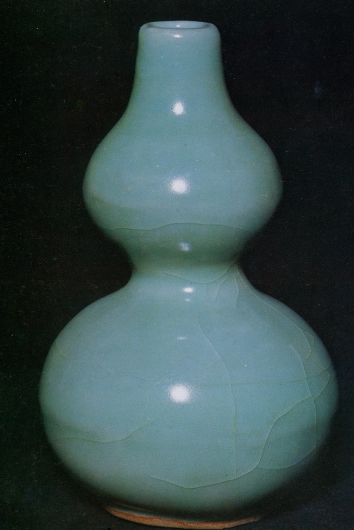
The Southern Song Dynasty (1127–1279) Longquan kiln gourd vase is universally regarded as a pinnacle of Chinese ceramic art. It represents the convergence of supreme technical skill, profound philosophical aesthetics, and potent cultural symbolism unique to this historical period.
I. Defining Characteristics & Significance
1. The Form: Symbolism and Elegance
- The Gourd Shape: Known as húlupíng (gourd vase) or dájípíng (great auspicious vase), its form is derived from the double-gourd, a potent symbol in Chinese culture. It represents good fortune (jí 吉), immortality, marital harmony, and the wish for numerous descendants, as the word for gourd (húlu) is a homophone for “protection” and “prosperity.”
- Southern Song Aesthetic: Unlike the robust shapes of earlier periods, Southern Song forms are characterized by a refined, understated elegance. The gourd vase exemplifies this with its perfectly balanced proportions, fluid, gentle contour, and seamless transition between its upper and lower bulbs. It embodies the Song literati ideal of serene, introspective beauty.
2. The Glaze: The Pursuit of Jade
The most revolutionary achievement of Southern Song Longquan is its glaze, developed to mimic the treasured quality of nephrite jade.
- Fenqing (Powder-Green): A soft, opaque, lavender-tinged blue-green. Its texture is matte and finely crackled, resembling the finest mutton-fat jade. It exudes a calm, subtle luminosity.
- Meiziqing (Plum-Green): A deeper, transparent, and glossy bluish-green, evocative of a ripe plum. This glaze is exceptionally thick and glassy, achieving a jewel-like depth and clarity.
- Both glazes are the result of advanced iron-reduction firing and multiple layered applications (often 3-4 coats), creating a glaze layer thicker than the body itself—a hallmark of top-quality Southern Song pieces.
3. Technical Execution
- Body and Foot: The stoneware body is fine-grained and grayish-white. The unglazed foot ring was carefully trimmed, often revealing the “iron-foot” —a dark, rust-brown rim caused by iron oxide in the clay reacting to oxygen during cooling.
- Firing: Meticulous control of the kiln’s reducing atmosphere and temperature was crucial. Potters used clay spurs for support in the saggar, leaving small, raw clay marks on the glaze inside the foot ring.
II. Appreciation and Connoisseurship
To evaluate an authentic Southern Song Longquan gourd vase, consider:
- Visual Harmony: The form should feel organic and poised, not stiff or mechanical.
- Glaze Quality: The surface should have a deep, soft, inner glow (often termed baoguang or “treasure light”). Look for subtle tonal variations and a smooth, tactile texture. Modern replicas often have a uniform, overly bright, or “plastic” shine.
- Aging Evidence: Authentic pieces show natural signs of centuries: gentle wear on raised points, a silky patina from handling, and possibly staining within the crackle network.
- Weight and Sound: It should feel substantial but not heavy. A gentle tap produces a clear, resonant ring, indicating a well-fired, uncracked body.
III. Historical Context and Legacy
- Cultural Shift: The move of the Song court south to Hangzhou (Lin’an) after 1127 placed the imperial heartland near the Longquan kilns in Zhejiang province. The court’s taste for refined, monochromatic wares for ritual and scholarly use directly fueled Longquan’s technical and aesthetic evolution.
- Global Influence: These celadons were major export commodities, reaching across Asia, the Middle East, and as far as East Africa. They profoundly influenced ceramic production in Korea, Japan, and later, even European porcelain.
- Market Position: Today, Southern Song Longquan gourd vases of verified quality and provenance are highlights in major museums (e.g., Palace Museum, National Palace Museum, British Museum, MET) and achieve top prices at international auctions. Distinguishing them from later (Yuan, Ming, Qing) imitations or modern reproductions requires expert knowledge, focusing on the specific nuances of glaze, form, and potting technique described above.
Conclusion
The Southern Song Longquan gourd vase is more than a vessel; it is a crystallized expression of an era’s highest cultural values. It marries auspicious symbolism with a form of pure, elegant simplicity, all encased in a glaze that forever changed the history of ceramics by successfully translating the eternal Chinese love for jade into fired clay. It remains a timeless benchmark for beauty and craftsmanship.