

In the world of contemporary ceramics, Chinese artists and designers are crafting a unique narrative. They are no longer merely guardians of a glorious past but are pioneering a bold new future. By weaving deep cultural heritage with modern sensibilities, they are creating vases that are not just vessels for flowers, but profound statements of art and design. Here’s a look at the defining trends shaping China’s local vase creation scene.
- Guochao: The Modern Rebirth of Tradition
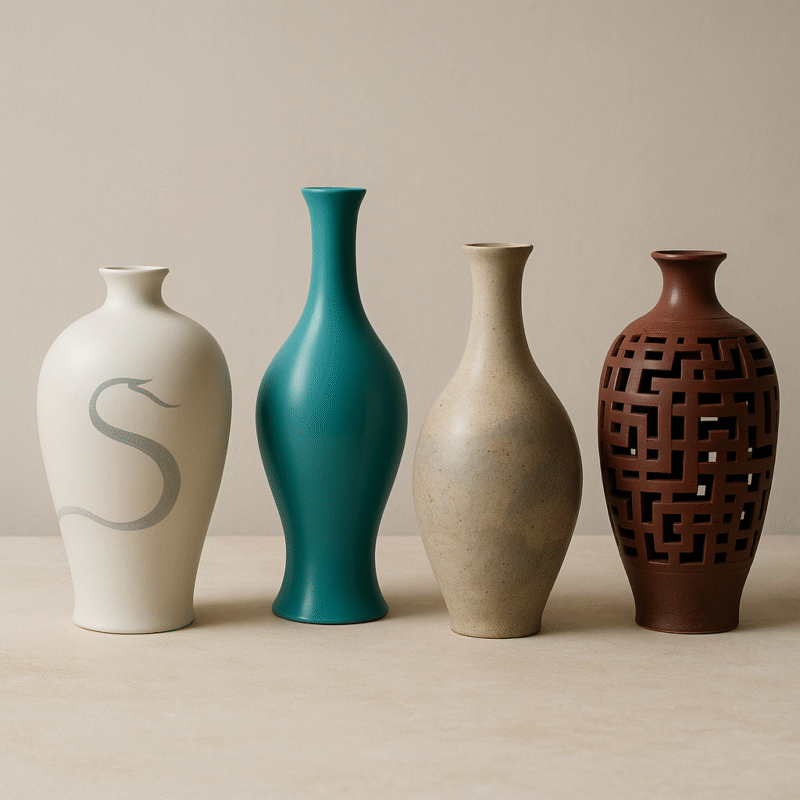
Deconstructed Cultural Symbols: Artists are abstracting classic elements. A Dragon pattern might be simplified into a flowing, minimalist line; a Song Dynasty landscape is hinted at with a single brushstroke and vast empty space.
Contemporary Silhouettes: The forms of classic vases, such as the Meiping (梅瓶) and Yuhuchun Ping (玉壶春瓶), are streamlined. Their elegant profiles are preserved, but distilled into cleaner, more architectural shapes that fit seamlessly into modern interiors.
Vivid Color Palettes: While respecting traditional hues, Guochao embraces bold, sometimes unexpected, colors. Think of vibrant enamel shades alongside serene celadon, creating a dynamic and youthful energy.
- Oriental Wabi-Sabi: The Poetry of Imperfection
Natural Textures: Vases showcase the raw, unadorned beauty of the material itself. Glazes like wood-ash (草木灰) and iron-rich (紫金土) are prized for their unpredictable results—drippings, crackles, and fire marks that tell the story of the kiln’s fire.
Muted, Earthy Tones: The color palette is soft and calming. Think beige, grey-brown, dusty rose, and misty blue—colors that evoke a sense of peace and tranquility.
The Vase as a Spiritual Anchor: These vases are more than decor; they are objects for contemplation. A single branch of cherry blossom in such a vase becomes a meditation on the passage of time.
- The Revival of Local Clays and Glazes
Beyond Jingdezhen: While Jingdezhen remains the undisputed capital, artists are championing the unique characteristics of clay from Yunnan (Jianshui purple clay 建水紫陶), Chongqing (Rongchang clay 荣昌陶), and elsewhere.
A Story in Every Piece: A vase made with the distinctive purple clay of Jianshui carries the essence of its region, connecting the owner to a specific cultural and geographical narrative.
- The Dialogue of Craft and Concept
Hybrid Techniques: It’s common to see a single vase that combines carving (刻花), underglaze blue (青花), and overglaze enamels (粉彩), creating layered and complex surfaces that defy easy categorization.
Linglong Reinvented: The ancient “Linglong” (玲珑) technique, which creates intricate pierced patterns, is being revolutionized. The traditional rice-grain patterns are now being replaced by geometric or abstract cut-outs, making the centuries-old technique feel utterly modern.
The contemporary Chinese vase is a bridge between past and future. It is a testament to a culture that honors its history without being bound by it. For the global audience, these vases offer a fresh and compelling perspective: that Chinese culture is a living, breathing, and ever-evolving force, beautifully embodied in the silent, elegant form of a vase.