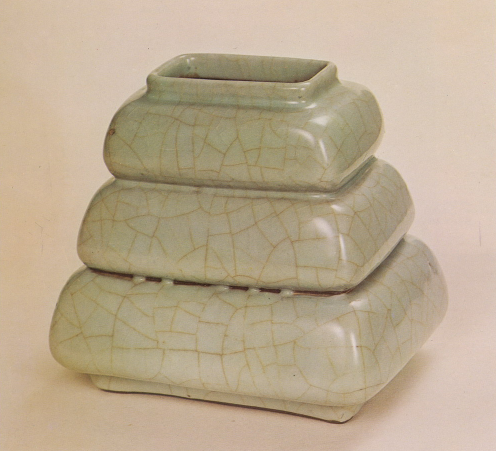


Analysis of Core Concepts
- “Northern Song Guan Ware”:
- This is a specialized term in ceramic history, specifically referring to the kiln established by the imperial court in the capital Bianliang (present-day Kaifeng, Henan) during the late Northern Song period (Emperor Huizong’s reign, around the early 12th century). Its products were exclusively for the imperial family and represent the pinnacle of Song ceramic aesthetics (subtle, reserved, elegant, and dignified).
- Important Note: Since Bianliang lies buried deep beneath the silt of the Yellow River, the kiln site of Northern Song Guan Ware has never been discovered. Therefore, there are no archaeologically excavated specimens to definitively confirm it. All extant pieces designated as “Northern Song Guan Ware” are preserved in the world’s top museums (e.g., the Palace Museum in Beijing, the National Palace Museum in Taipei, the British Museum). Their attribution relies primarily on historical court records, documentary research, and expert connoisseurship, and remains a subject of academic debate.
- “Fenqing” (Powder-Green):
- Refers to the glaze color. It is a type of celadon glaze, characterized by a thick, opaque layer. The color resembles pale, elegant jade, somewhere between greenish-blue and light blue. It is warm, moist, luminous, and translucent, representing one of the most classic glaze colors of Song Guan Ware.
- “Three-Tier Square Hu”:
- “Three-Tier” (San Deng): Indicates that the body of the vessel is formed by three stacked, square-shaped sections that gradually decrease in size from bottom to top, creating a solemn, austere sense of rhythm and architectural structure. “Deng” implies ascending or stepping.
- “Square Hu”: A square-shaped hu (a type of ancient ritual vessel). During the Song dynasty, ceramics imitating bronze vessel forms were an important source of high-end decorative or ritual objects. The square hu shape originates from Shang and Zhou dynasty bronzes, conveying an aura of antique elegance and nobility.
Comprehensive Description of the Object
Combining the above elements, the “Northern Song Guan Ware Fenqing Three-Tier Square Hu” describes an object with:
- Form: Archaistic bronze-style shape, constructed by stacking three square, terrace-like sections. It typically features shoulder handles or applied animal-mask rings (pushou). The form is square and upright, with rigid lines and a strict, precise structure, full of archaic flavor and a sense of power.
- Glaze Color: Covered entirely in a thick, powdered-green glaze. The glaze texture is like congealed fat, with a soft luster and an opaque, milky quality.
- Crackle (Crazing): The glaze surface should exhibit natural crackle patterns, such as “golden threads and iron lines” or ice-crackle, adding textural beauty.
- Base and Foot: A ring foot. The unglazed area on the base and foot should show a dark brown color (“iron foot”). The body clay is dense and dark (“purple mouth and iron foot” is a typical characteristic of Guan Ware).
Significance and Current Status
- Extreme Rarity: Such complex, ceremonially significant decorative vessels, which were extremely difficult to fire, had minimal output even during the Song Guan Ware period. Examples surviving intact to the present day are exceedingly rare.
- Epitome of Song Aesthetics: It perfectly combines archaic bronze form, jade-like glaze color, and naturally formed crackle, embodying the philosophical pursuit of “following the way of nature” and “investigating things to extend knowledge” (gewu zhizhi) during Emperor Huizong’s reign, as well as the ultimate in refined artistic taste.
- Provenance and Collection History: If authenticated as genuine, it would almost certainly be a piece from the Qing imperial collection with a clear, documented lineage. Objects of similar form and quality are primarily housed in the Palace Museum in Beijing and the National Palace Museum in Taipei. For instance, the National Palace Museum in Taipei holds a famous “Southern Song Guan Ware Celadon Three-Tier Square Hu,” often regarded as the benchmark object for this type.
Key Point of Discussion: Northern Song vs. Southern Song
- In academic and museum circles, there is a long-standing debate regarding the attribution of many Guan Ware pieces as either “Northern Song” or “Southern Song.”
- Southern Song Guan Ware (from kilns like Laohudong and Jiaotanxia in Hangzhou) has confirmed kiln sites, and its products are extremely similar to the legendary “Northern Song Guan Ware.” Many pieces once attributed to the “Northern Song” are now more cautiously attributed to the “Southern Song.”
- Therefore, the object you inquired about, the “Northern Song Guan Ware Fenqing Three-Tier Square Hu,” is more likely to be cataloged or exhibited in public records as a “Southern Song Guan Ware Fenqing-Glazed Three-Tier Square Hu.” This is not a devaluation but a refinement of scholarly understanding. It remains one of the supreme masterpieces of Song Guan Ware.
Conclusion
The “Northern Song Guan Ware Fenqing Three-Tier Square Hu” is a ceramic treasure that merges archaistic form, supreme glaze color, and top-tier craftsmanship, symbolizing the apex of Song dynasty ceramic art. Whether such a specific piece exists and where it might be housed requires verification against the most authoritative museum archives. Currently, the most famous known example of this type is housed in the National Palace Museum in Taipei and is attributed to the Southern Song period.