

Core Characteristics and Key Identification Points
Historical Context:
- Produced during the Ming Xuande period (1426–1435 AD), it is official ware from the Imperial Kilns.
- This era is regarded as a golden age for Chinese blue and white porcelain, often mentioned alongside the Yongle period. The cobalt blue used was predominantly imported “Sumali blue,” known for its vivid, deep color, characteristic “iron-rust spots,” and a natural, hazy bleeding effect.
Decorative Motif – “I-Shu-Lian” (A Bunch of Lotus):
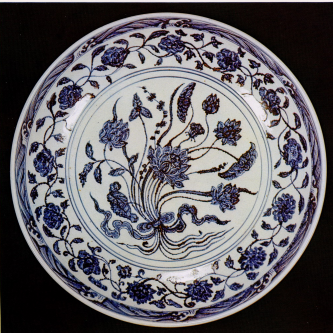
- Design: The center of the plate features a tied bunch of aquatic plants – typically lotus, arrowhead, knotweed, and cattail – bound with a ribbon. This motif is not arbitrary; it carries the homophonic symbolism of integrity. “Yi Shu Lian” sounds like “Yi Pin Qing Lian,” expressing the expectation for officials to be upright and honest. It is a classic “official pattern” of imperial porcelain.
- Layout: The interior walls are often decorated with auxiliary patterns like scrolling flowers, waves, or vine scrolls. The exterior usually features similar scrolling lotuses or floral sprays. The overall composition is balanced, spacious, and painted with natural, fluent brushstrokes.
Form and Craftsmanship:
- Form: Typically has a wide mouth, rounded sides, and a ring foot. The shape is dignified, stable, and well-proportioned.
- Cobalt and Color: Classic Xuande blue and white uses Sumali blue, producing a rich, brilliant blue. Key identifying features are the natural iron-oxide spots and bleeding within the painted lines.
- Glaze: The glaze is thick, lustrous, and moist, usually showing a clear, bright blue tint. The surface often has a fine, orange-peel texture called “orange-peel glaze.”
- Body and Foot: The body clay is fine, white, and dense. The foot rim is neatly finished. A distinctive period feature is the treatment of the ring foot: the outer edge is straight, while the inner edge slopes inward, and the base is often coated with a clear glaze. Unglazed bases may show traces of “fire-skin red.”
Mark:
- The vast majority bear the imperial reign mark in six characters: “Da Ming Xuan De Nian Zhi” (Made in the Xuande reign of the Great Ming). It is written in regular script, typically in two columns within a double circle. The calligraphy is powerful and precise. The mark can be found either in the center of the plate or below the rim on the exterior.
Artistic and Market Value
- Historical & Artistic Value: Represents the peak of early Ming imperial porcelain production and is a standard reference piece for Xuande blue and white. Its pattern is deeply symbolic, and its craftsmanship is exquisite. It was so admired that it was meticulously copied by later dynasties, especially during the Qing Yongzheng and Qianlong reigns.
- Market Value: A genuine Xuande blue and white “I-Shu-Lian” plate in excellent condition is a star lot in top-tier international auctions and commands an extremely high price. Depending on size, condition, and provenance, prices can range from several million to tens of millions of RMB. Premier institutions like the Palace Museum in Beijing and the National Palace Museum in Taipei hold fine examples.
Important Notes and Authentication
- Numerous Imitations: This design has been copied from the late Ming period onward, with particularly fine imitations made during the Qing Kangxi, Yongzheng, Qianlong reigns, and the late Qing/Republic period. High-quality modern replicas are also common.
Key Authentication Points:
- Cobalt: Modern replicas struggle to imitate the natural iron-spotting and bleeding of Sumali blue. They often use chemical dyes, resulting in a flat, harsh color.
- Body and Glaze: Antiques have a soft, moist luster, and the body shows appropriate age. New fakes often have a harsh, glossy shine, and the body can be overly white or heavy.
- Craftsmanship & Painting: Antique brushwork is confident and fluid. Imitations often appear stiff and hesitant. The method of finishing the foot rim is a critical dating clue.
- Mark: Xuande marks have a distinct period style and must be carefully compared with verified standard pieces.
Collecting Advice:
- Exercise extreme caution if encountering such a piece on the market. High-level originals with clear provenance are mostly housed in museums or held by established collectors.
- If considering acquisition, essential steps include seeking authentication from authoritative experts/institutions and thoroughly verifying its ownership history.
Extension: Qing Dynasty Copies
- The Qing imperial kilns (especially under the Yongzheng and Qianlong Emperors) were ordered to produce precise copies of Xuande “I-Shu-Lian” plates. These Qing copies are sometimes even more technically refined, using domestic cobalt for a more uniform blue. Crucially, they bear the reign mark of their own period. These are themselves highly valuable imperial wares and should not be confused with modern forgeries.
Summary
The “Xuande Blue and White ‘I-Shu-Lian’ Plate” is a national treasure-level porcelain that combines peak period craftsmanship, a definitive imperial motif, and profound cultural symbolism. It is not only a benchmark for Xuande official ware but also a radiant jewel in the history of Chinese ceramics.