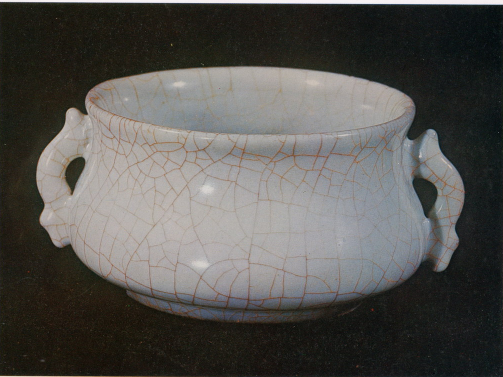


The “Southern Song Ge Ware ‘Powder-Blue’ Fish-Handled Ritual Censer” you mentioned is an exceptionally famous and precious ancient Chinese ceramic artifact. It represents the pinnacle of ceramic craftsmanship from the Song Dynasty, particularly from the mysterious and highly revered Ge Ware.
Below is a detailed interpretation of this object:
Basic Information
- Dynasty: Southern Song (1127–1279 AD)
- Kiln: Ge Ware (one of the “Five Great Kilns” of the Song Dynasty)
- Glaze Color: Fenqing (“Powder-Blue”)
- Form: Yi-type Censer (modeled after ancient bronze ritual vessels known as “Yi“)
- Distinguishing Feature: Fish-shaped Handles
Core Characteristics and Artistic Value
- The Legendary Status of Ge Ware:
- Records of Ge Ware in Song documents are vague, and its origins remain one of the great mysteries in ancient ceramic scholarship. It is closely associated with Guan (Official) Ware, often discussed together as “Guan and Ge are hard to distinguish.”
- Its most defining characteristic is “crackling” (the natural crackle pattern in the glaze). This initially “flawed” effect, caused by the different cooling contraction rates of the glaze and the body, was ingeniously transformed by Song artisans into a natural and philosophically resonant decorative art.
- The Enchanting “Powder-Blue” Glaze:
- “Fenqing” is a type of celadon glaze. The glaze layer is thick and opaque. Its color resembles a clear sky after rain or pale green jade—a soft, elegant, warm, and restrained blue-green.
- This glaze color, combined with the delicate crackle patterns, embodies change within serenity, perfectly reflecting the “reserved, natural, and elegant” aesthetic taste revered by Song Dynasty literati.
- The Archaistic “Ritual Censer” Form and “Fish Handle” Design:
- Archaisim: The “Yi” was a bronze wine or ritual vessel from the Shang and Zhou periods. With the rise of epigraphy in the Song Dynasty, archaism (imitating ancient objects) became fashionable. This censer’s form derives from the bronze Yi, but its lines are more rounded and simplified, removing ornate decoration to highlight the beauty of the glaze. It is a prime example of “learning from antiquity without being constrained by it.”
- Fish Handles: The pair of symmetrical fish-shaped handles on the body are the focal point. In traditional culture, the fish symbolizes “abundance” and “auspiciousness.” Furthermore, the curved form of the fish adds a sense of liveliness to the solemn vessel shape. The handles are typically executed in relief or appliqué, simple yet vivid.
- “Golden Threads and Iron Wires” Crackle (A typical Ge Ware characteristic):
- Ge Ware crackle often has layers: larger, darker cracks (“iron wires”) interlace with finer, golden-yellow cracks (“golden threads”), forming a “hundredfold fragment” or “ice crackle” network. This effect is achieved by soaking the fired object in ink or tea to stain the cracks, a process that deepens over time.
- The crackle on the “Powder-Blue Fish-Handled Censer” is likely more subtle and delicate, complementing the gentle glaze color.
Significance and Collecting
- Such objects were extremely precious even during the Southern Song, likely used only by the imperial court or high-ranking literati.
- Complete Ge Ware vessels surviving from the Song Dynasty are exceedingly rare; each is a national treasure.
- The National Palace Museum in Taipei holds a “Southern Song Ge Ware Celadon Fish-Handled Censer,” considered the benchmark and masterpiece of this type. It is a permanent exhibit and one of the museum’s treasures. The “Powder-Blue Fish-Handled Yi Censer” you described likely refers to this piece or a similar one.
Summary
The Southern Song Ge Ware ‘Powder-Blue’ Fish-Handled Ritual Censer is an artistic masterpiece that fuses the highest ceramic technology, profound cultural spirit, and unique aesthetics of the Song Dynasty.
It combines:
- Mysterious Kiln Fire (The enigma of Ge Ware),
- Jade-like Glaze (Powder-Blue),
- Heaven-sent Patterns (Crackle),
- Archaistic Form (Ritual Censer),
- Auspicious Ingenuity (Fish Handles)
into a single object. It is not merely a functional item (an incense burner) but a sculptural work embodying philosophical thought, antiquarian interest, and scholarly taste. It silently expresses the refinement and atmosphere of that culturally peak era from eight hundred years ago.
If you encountered this object in a museum or catalog, you were looking at one of the most captivating classics in the history of Chinese ceramics.