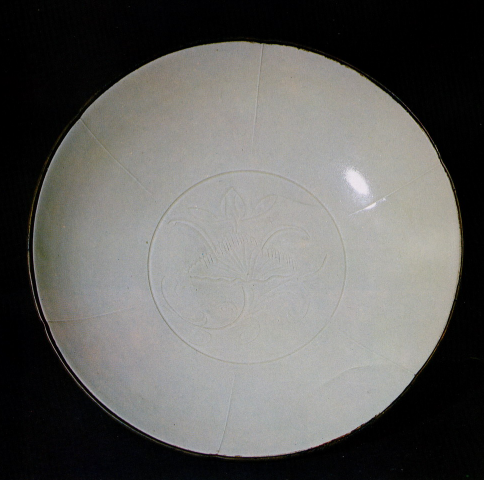
This Ding ware dish is renowned for its soft, jade-like ivory-white glaze, simple and elegant form, and fluid, lively carved lotus decoration. It perfectly embodies the minimalist aesthetic and restrained elegance of Song dynasty ceramics, which pursued a natural beauty described by the phrase “emerging clear from the water, naturally carved and decorated.”
Detailed Analysis and Characteristics
- Kiln and Period: Northern Song Ding Ware
Ding Ware: One of the Five Great Kilns of the Song Dynasty (Ru, Guan, Ge, Jun, Ding) and the only one primarily focused on producing white porcelain. Its kiln sites were located in present-day Quyang County, Hebei Province.
Northern Song Period: This was the golden age of Ding ware production. Its products were of exquisite quality with elegant decorations, often serving as tribute ware for the imperial court.
- Glaze Color:
The classic Ding white is not pure white but has a warm, moist texture often described as ivory white or cream-white. The glaze surface is lustrous, with areas where the glaze pools potentially showing a faint yellowish-green hue.
This warm white, later praised as “white with a yellowish tint,” gives a soft and refined feeling, distinct from the pure white porcelain styles of the Yuan, Ming, and Qing dynasties.
- Decoration: Carved Lotus Design
Technique: “Carving” (huahua). This technique involves incising the design into the leather-hard clay body using a needle-like tool made of bamboo, wood, or metal. The lines are fluid, varying in depth, and possess an elastic quality. They are less rigid than engraved lines and less uniform than molded patterns, but they have a unique painterly and lively feel.
Motif: Lotus Flower. The lotus was an extremely popular decorative theme in the Song dynasty. It possesses not only natural beauty but also carries profound cultural meaning:
Buddhist Symbolism: Rising unstained from the mud, it represents purity and detachment.
Scholarly Virtue: Symbolizes the noble character of a gentleman, aligning with the imagery in Zhou Dunyi’s “Ode to the Lotus”: “Standing tall and clean, they can be admired from a distance but must not be treated disrespectfully.”
Auspicious Meaning: Represents integrity, good fortune, and continuity (the seed-packed lotus pod).
- Form and Craftsmanship:
Form: Typically characterized by a wide mouth, shallow sides, and a ring foot. The lines are concise and graceful, with well-proportioned shapes that balance utility and aesthetics.
Unglazed Rim (kouchang or “mouth rim)**: This is a very important characteristic of Ding ware. To increase output, Ding kilns pioneered the firing method upside-down, stacking dishes rim-to-rim. This maximized kiln space, but to prevent the mouth rim from fusing to the firing supports, the glaze was wiped from the rim before firing, exposing the bare clay body—this is the “unglazed rim.”
To compensate for this aesthetic drawback, nobles of the time often mounted the unglazed rim with a band of gold, silver, or copper, known as “bound rim” decoration, which itself became a distinctive feature.
Artistic and Cultural Value
This carved lotus dish is not merely a utilitarian object but a vessel of Song dynasty aesthetic philosophy:
Minimalism: It rejects bright colors and complex ornamentation, winning admiration through its simple glaze color and natural motifs.
Introspective Mood: Its beauty is not ostentatious but quiet and profound, requiring calm contemplation to appreciate its serenity, depth, and subtle charm.
Harmony between Heaven and Man: The carving technique mimics the brushstroke of a calligrapher’s brush, full of manual warmth. The lotus motif, derived from nature yet idealized, reflects the Song literati’s philosophical ideal of harmonious coexistence with nature.
Summary
This Northern Song Ding Ware Carved Lotus Dish, with its warm ivory-white glaze, fluid and lively carved decoration, lofty lotus theme, and unglazed rim resulting from upside-down firing, collectively constitutes its irreplaceable artistic value. It is a paradigm of the pinnacle of Song dynasty ceramic art, crystallizing the aesthetic taste, technical proficiency, and cultural spirit of that era, and is still regarded as a treasure today.