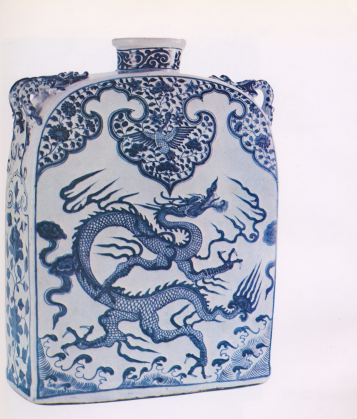
The Yuan Dynasty Blue-and-White Dragon-Design Flat Flask represents the pinnacle of Yuan porcelain and is a highly iconic masterpiece in the history of Chinese ceramics. It embodies the quintessential characteristics of Yuan blue-and-white ware and imperial majesty. Extant examples are extremely rare and are considered priceless treasures.
Below is a detailed analysis of this precious artwork:
Core Characteristics
- Unique Shape – The Flat Flask:
- This form is not traditional to Chinese ceramics but was heavily influenced by metalware from Central and West Asia (Persia, the Arab world). The vast territory of the Yuan Dynasty facilitated frequent cultural exchanges. This flat shape, suitable for carrying with ropes, was ideal for the nomadic, equestrian lifestyle, making it a classic example of the era’s multicultural fusion.
- The body is flattened, typically with loop handles or dragon-shaped lugs on the shoulders for attaching cords.
- Decorative Motif – The Dragon Design:
- Dragon Imagery: The dragon motif of the Yuan Dynasty possesses distinct period traits. The dragon’s head is small, elongated, and devoid of a mane. Its eyes are shaped like knives, with an open mouth revealing teeth, conveying a fierce and imposing aura. The body is slender, powerful, and agile, often adorned with flame-like, flowing scales. The claws usually have three or four talons (five-clawed dragons became more common in the late Yuan and Ming/Qing periods).
- Composition: The dragon typically serves as the primary decoration, coiling or winding across the main surface of the flask. It is often accompanied by secondary patterns such as clouds, crashing waves, or flames, creating a dynamic sense of the dragon soaring through the heavens or commanding the seas.
- Blue-and-White Technique:
- Cobalt Pigment: Imported “Sumali” cobalt was used. This pigment is high in iron and low in manganese. After firing, it produces a rich, intense blue color with distinctive iron-brown speckles and a haloing or diffuse effect, resulting in remarkable depth and tonal variation—a signature and captivating feature of Yuan blue-and-white.
- Painting Style: Employing techniques from traditional Chinese ink wash painting, the brushwork is fluid and unrestrained, often executed with single, confident strokes. The artisans’ exceptional skill vividly captures the dragon’s ferocity and vitality.
Important Example: The Blue-and-White with Copper-Red Underglaze Openwork Jar (A Dragon Motif Paradigm)
When discussing Yuan blue-and-white dragon designs, one national treasure must be mentioned. Though not a standard flat flask, it perfectly exemplifies the essence of the Yuan dragon motif:
- Name: Yuan Dynasty Blue-and-White with Copper-Red Underglaze Openwork Jar and Cover
- Collection: Hebei Museum
- Features: This jar combines multiple techniques: underglaze blue, underglaze copper-red, openwork, and appliqué. Its sides feature openwork designs of flowers representing the four seasons, interspersed with paintings of blue-and-white and copper-red dragons. The dragons appear fierce and agile, their visual impact magnified against a backdrop of blue clouds and copper-red splashes. It represents the highest technical achievement of the Jingdezhen kilns during the Yuan Dynasty.
Market Value and Status
- National Treasure: Yuan blue-and-white ware itself is exceedingly rare. Large, intact vessels with complete dragon designs (such as large jars, meiping vases, or flat flasks) are even rarer, primarily housed in the world’s top museums (e.g., the Palace Museum, British Museum, Topkapi Palace in Turkey).
- Auction Records: In the art market, Yuan blue-and-white holds legendary status. For instance, the 2005 sale of the “Guiguzi Descending the Mountain” Yuan blue-and-white jar for approximately 2.3 billion RMB stunned the world. A “Yuan Blue-and-White Dragon-Design Flat Flask” with excellent condition and clear provenance appearing on the market would undoubtedly command a value in the hundreds of millions, placing it among the most elite collectibles.
Key Authentication Points (Brief)
Encountering such pieces requires extreme caution. Key aspects to consider include:
- Body: Yuan blue-and-white bodies are substantial and heavy. Larger pieces may feel slightly coarse, with visible joining marks where sections were luted together.
- Cobalt Color: Does it exhibit the typical characteristics of Sumali blue (vivid, iron spots, haloing)?
- Dragon Painting Style: Does it match Yuan period traits (small head, slender body, no mane, fierce expression)?
- Craftsmanship: The flat flask shape is complex to produce. Does it show period-appropriate techniques?
- Base/Foot: The base of Yuan porcelain is usually unglazed, showing “fire-red” (oxidized iron) or sand adhesion on the exposed clay.
In summary, the Yuan Dynasty Blue-and-White Dragon-Design Flat Flask is a crystallisation of cultural exchange, a symbol of its era’s aesthetics, and a milestone in ceramic technology. It is not merely a utilitarian or decorative object but also a historical witness to the Mongol Yuan Empire’s formidable power and cross-cultural interactions, holding an irreplaceably lofty position in the history of Chinese art.