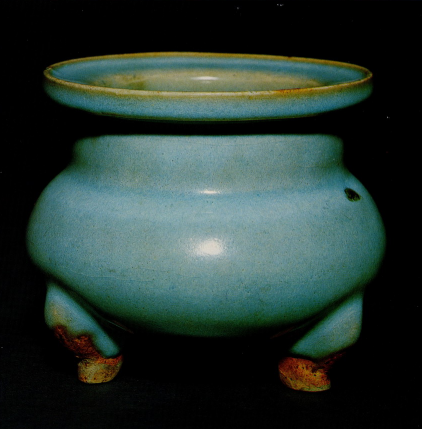


Core Characteristics: Jun Ware and “Celadon (Tianqing)”
- Status of Jun Ware: Jun ware is one of the “Five Great Kilns” of the Song Dynasty (Ru, Guan, Ge, Jun, Ding), renowned for its flambé glazes. Its main production center was in Yuzhou, Henan (known as Junzhou in ancient times).
- Celadon (Tianqing) Glaze: “Celadon” or “Tianqing” (literally “sky blue”) is one of the foundational glaze colors of Jun ware, a poetic imitation of the color of the sky after rain. It is not a simple blue but a soft, bluish-green hue with a faint opalescent glow, warm and subtle, with a glaze texture thick and creamy like congealed fat. While often used as a base for dramatic purple or red “flambé” splashes, pieces with a pure, even celadon glaze are also highly esteemed.
Form and Function: The Censer’s Shape and Use
- Form: Common shapes for Song Dynasty Jun ware censers include the “ding-style” censer (three legs, imitating ancient bronze tripods), the “li-style” censer (three pouch-shaped legs), or the “gui-style” censer (with two handles and a ring foot). The designs are generally simple, dignified, and robust, reflecting the Song aesthetic of elegant restraint (“yazheng”).
- Function: Censers in the Song Dynasty were primarily used for incense burning in rituals, Buddhist worship, or scholarly gatherings, serving as vessels for spiritual life and ceremony. As a high-grade ceramic, a Jun ware censer was likely used by the imperial court, aristocracy, or temples.
Craftsmanship and the Beauty of the Glaze
- The Mystery of Flambé: Jun ware employs a “twice-fired” process: the body is first bisque-fired, then a thick glaze is applied and fired at high temperature. The glaze contains metallic elements like copper and iron, which create complex flambé effects in a reducing atmosphere. Achieving a pure, even celadon glaze requires extremely precise firing conditions.
- “Earthworm Track” Marks: On some Jun ware pieces, the glaze surface exhibits winding, thread-like patterns resembling the tracks of earthworms in mud. This is an important authenticating characteristic, caused by cracks in the glaze layer that healed and flowed during drying or firing.
- Body Material: The clay body is fine-textured, greyish-brown in color (often called “incense-ash” paste), and sturdy.
Historical and Collectible Value
- Song Dynasty Jun Ware: The Song Dynasty, particularly from the late Northern Song to the Jin period, represents the golden age of Jun ware production. Works from this time are known for their elegant glazes and disciplined forms, often intended for imperial display or scholarly use.
- Later Influence: Production continued in the Yuan and Ming dynasties, but glazes tended to become heavier and forms more robust. The Yongzheng and Qianlong reigns of the Qing Dynasty saw vigorous attempts to imitate Jun glazes, though the style reflects Qing-era refinement.
- Survival and Collection: Intact Song Dynasty Jun ware pieces are rare, and a celadon-glazed censer is exceptionally scarce. Major examples are housed in top-tier museums such as the Palace Museum in Beijing, the National Palace Museum in Taipei, and a few important private collections. Any genuine piece appearing on the market would be considered a national treasure, commanding immense value.
Important Note: Authentication and Understanding
- Many Imitations: Due to its prestige, Jun ware has been widely imitated throughout history—during the Yuan, Ming, Qing dynasties, and modern times. Song pieces are distinguished by a more subtle, moist-looking glaze, a characteristic brown edge at the glaze-foot junction (from a protective slip), and more harmoniously proportioned, archaic forms.
- The Term “Jun Ware”: The term “Jun kiln” does not appear directly in Song documents; the name was later derived from its place of origin. Scholars still debate the precise dating of some “Song” Jun ware (whether all are from the Northern Song), but its artistic achievement is undeniable.
Cultural Significance
The Song Dynasty Jun Ware Celadon Censer embodies the Song Neo-Confucian ideal of “harmony between heaven and humanity” in aesthetic form—the flambé effects, beyond human control, are like creations of nature itself. The celadon color evokes contemplation of the sky and the cosmos. It is not merely a utilitarian object but a perfect fusion of Song scholarly spirit and technical artistry.