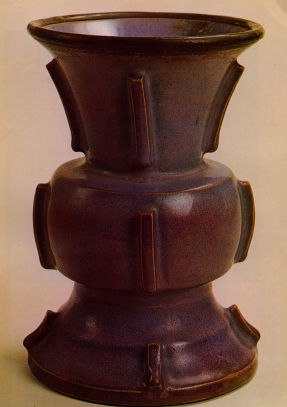


Detailed Analysis
1. Regarding “Lilac Purple”
- “Purple” in Song Dynasty Jun Ware: Song Jun ware is famed for its “yao bian” (kiln transformation) glazes. Its purple color results from copper-red glaze interacting with sky-blue glaze in a reducing atmosphere, creating effects like “rose purple” or “begonia red.” This purple is naturally flowing, unpredictable, and usually appears as splashes or partial tones blending with sky-blue or moon-white, forming “purple splashes” or “rosy clouds.”
- Origin of “Lilac Purple”: The specific and poetic name “Lilac Purple” is more commonly found in Qing Dynasty literature and court descriptions of Jun ware glazes. The Qing imperial kilns at Jingdezhen extensively copied Jun glazes, pursuing stable, even purple glaze surfaces and bestowing elegant names like “eggplant-skin purple” and “lilac purple.” Therefore, “Lilac Purple” is a later (especially Qing court) idealized classification and naming for Jun glaze colors.
2. Regarding the “Zun” Form
- Common Song Jun Ware Forms: Song Jun ware consisted mainly of utilitarian or decorative vessels, such as flower pots, pot stands, chuji zun (ritual zun vessels with flange-like protrusions), drum-nail washers, bowls, and dishes. The “zun” category specifically refers to chuji zun (imitating Shang-Zhou bronze zun forms with flange-like protrusions), a classic decorative form of Song Jun ware.
- Qing Archaistic Zun: The Qing court was steeped in archaism. They imitated Song Jun ware forms (like the chuji zun) but also innovated or blended forms from other periods, often inscribing them with imperial poems. These pieces were frequently recorded by the Qing court as “Song Jun ware.”
3. The Most Likely Reference — Qing Palace “Jun Ware”
The collections of the Palace Museums in Beijing and Taipei include a group of “Jun ware” pieces with numbered marks (e.g., “one” to “ten”) on their bases, often accompanied by Qianlong’s inscribed poems. Scholarly consensus holds that:
- Period: Many of these were produced in the Ming or even Qing Dynasties.
- Characteristics: Their glazes are even, purple splashes show more controlled, artificial application (pursuing effects like “lilac purple”), forms are regular, and they bear clear signs of imperial production and later alteration (inscriptions).
- Naming: The Qing court cataloged them as “Song Jun ware,” inscribing poems, fitting them with stands, and treasuring them accordingly. These objects are the physical origin of the later concept “Song Jun Ware ‘Lilac Purple’ Zun.”
Speculative Features of a Typical Object
If it is a typical Qing palace collection piece called a “Song Jun Ware ‘Lilac Purple’ Zun,” it might have these features:
- Form: A zun-type vessel archaizing the Song chuji zun or bronze shapes, elegant and classical.
- Glaze Color: Fully or largely covered with an even, light, elegant purple tone resembling lilac flowers. The glaze surface is lustrous and smooth, possibly with slight flowing but generally uniform.
- Craftsmanship: The base is usually glazed, showing spur marks from firing.
- Crucial Markings: The base may be incised with an imperial poem by Qianlong or a later emperor, hall names like “Jianfu Gong” or “Ninghui Tang,” or appraisal characters like “Jia,” “Yi,” “Bing.” It may also have a numbered mark “one” to “ten” (indicating size).
- Packaging: Originally accompanied by a red sandalwood stand and brocade box, with a Qing palace yellow label reading “Song Junyao Dingzizi Zun” (“Song Jun Ware Lilac Purple Zun“).
Artistic and Collectible Value
- Historical Value: Such objects witness the flourishing of Qing court culture, epigraphy, and archaism, reflecting the emperor’s interpretation and recreation of Song aesthetics.
- Artistic Value: Their exquisite glaze colors and dignified forms represent the high technical and aesthetic standards of Qing imperial kiln archaistic ware.
- Market Perception: In traditional collecting circles, they have always been treasured for their clear Qing palace provenance and fine craftsmanship. However, in modern academia and more rigorous collecting systems, a clear distinction is made between their manufacturing period (Ming/Qing) and their court designation period (Qing).
Summary
The name “Song Dynasty Jun Ware ‘Lilac Purple’ Zun Vessel” is essentially a cultural concept blending Song aesthetic ideals, Qing court archaistic craftsmanship, and collection cataloging practices. The physical object it refers to is most likely a Qing Dynasty imperial archaistic zun vessel, made in the style of Song Jun ware, pursuing a lilac-purple glaze, and bearing Qianlong-era court markings.
To accurately assess a specific object, the key is to examine its base features (numbers, imperial poems), glaze texture, formal details, and provenance. A genuine Song Dynasty Jun chuji zun would have more dynamic, natural, and fluid purple splashes and would absolutely lack later imperial inscriptions.