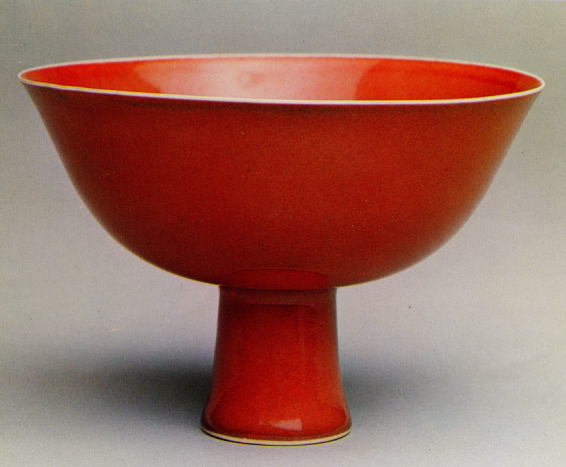
1. Core Characteristics & Definition
- Yongle Porcelain: Refers to official ware from the Yongle period (1403-1424) of the Ming Dynasty. Yongle porcelain is renowned for its fine body, warm glaze, and elegant forms, representing one of the peaks of Ming official ware production.
- Sacrificial Red (Jihong): Also known as “Jihong” (clear sky red) or “gemstone red,” it is a high-temperature copper-red glaze. Its color is deep, solemn, uniform, and pure, resembling a clear sky after rain or a ruby, hence the name “Jihong” (clear red). As it was primarily used for imperial sacrificial vessels, it is also called “Sacrificial Red” (Jihong). Firing this glaze requires extremely precise atmospheric conditions and temperature control, resulting in a low success rate and making it particularly precious.
- Stem Plate (Gao Zu Pan): Also called a “stem dish” or “stand dish,” it is a plate-shaped vessel with a tall, columnar stem (for easy handling). Its form was likely influenced by Central Asian metalwork, popular during the Yuan and Ming periods, and was used in imperial or religious settings for displaying fruit or as sacrificial ware.
2. Historical & Technical Context
- The Status of Yongle Red Glaze: The Yongle period revived and advanced high-temperature copper-red glaze technology, which had been interrupted since the Yuan Dynasty. “Sacrificial Red” glaze is a representative achievement. It differs from the brighter “gemstone red” of the Xuande period or the glassy texture of Lang kiln red. Instead, it has a rich, lustrous glaze with a dark red hue tinged with subtle purple, exhibiting a reserved and introverted charm.
- Firing Difficulties: Copper-red glaze is fired in a reducing atmosphere and is highly sensitive to kiln temperature and conditions, leading to the saying “one treasure in a thousand kilns.” Successful examples have an even, crackle-free glaze surface. The rim often shows a distinct white line (“rush rim” or dengcao kou) where the glaze has thinned, revealing the white body beneath, and the glaze tends to pool thickly at the base of the stem.
- Function: As the name implies, “Sacrificial Red” was likely related to the Ming imperial sacrificial system. The Collected Statutes of the Ming Dynasty (Da Ming Hui Dian) records specific color regulations for sacrificial vessels, such as “red for the Altar of the Sun.” Such stem plates might have been used for sun worship or other important ceremonies.
3. Key Points for Authentication (if examining a physical object or images)
- Form: Yongle stem plates feature smooth, flowing lines. The stem is slender and straight, often with bamboo-like nodes or left plain. The proportions between the bowl and stem are harmonious, and the joint where they are luted together is expertly finished.
- Glaze Color: Authentic Yongle “Sacrificial Red” is not a bright red. As suggested by the reference image you might have seen, it is a deep, intense red with a slight purplish tint. The glaze surface should be rich, lustrous, and have a soft, jade-like quality with an inner glow.
- Body and Foot: The clay is fine and white (using Mazang clay). The foot rim is neatly finished, typically flat-cut, and may occasionally show slight rusty-red “fire-smoke red” (huoshi hong) traces.
- Marks: Most Yongle official wares are not marked with reign periods. Only a few items, like “yashou” cups, bear underglaze seal-script marks hidden within the design. If a piece bears a blue-and-white “Yongle” reign mark, extreme caution is warranted, as such marks are exceptionally rare on “Sacrificial Red” glazed wares.
4. Market & Collection
- Genuine Yongle “Sacrificial Red” stem plates are extremely rare. They are almost exclusively found in top-tier museums like the Palace Museum in Beijing or the National Palace Museum in Taipei. Their appearance on the open market is highly unlikely.
- Later periods, especially the Qing Dynasty reigns of Kangxi, Yongzheng, and Qianlong, produced imitations of Yongle and Xuande red glazes. Yongzheng period imitations are of particularly high quality but bear their own reign marks. Imitations also exist from the late Qing, Republic period, and modern times.
- In the auction market, early Ming official red-glazed porcelains command astronomical prices when they appear. For example, an early Ming ‘Jun’-type red-glazed stem bowl has sold for tens of millions of HKD at auction, and “Sacrificial Red” wares are typically ranked even higher.